
Liquid AI's LFM2.5 Beats 9B Models on Tool Use Running on a Phone
Liquid AI's 2.6B parameter agent model runs entirely on-device at 220 tokens per second, fits in 2.5 GB, and beats models four times its size on tool use.
Takeaways
- Liquid AI released LFM2.5-2.6B-GGUF, a 2.6B parameter on-device agent model, under 2.5 GB memory.
- Hits 220 tok/s on M5 Max, 113 on Ryzen AI, 30 on a smartphone CPU.
- Beats Qwen3.5-9B on ToolSandbox (77.83 vs 76.44) despite being roughly 4x smaller.
- Architecture: 22 short-convolution blocks plus 8 grouped-query attention layers, 128K context, 16 languages.
- Trained on ~34T tokens with four-stage post-training including multi-turn agentic RL inside real harnesses.
- Open weights, GGUF/MLX/ONNX day-one, works with llama.cpp, Ollama, vLLM, LM Studio, Jan.
Liquid AI has released LFM2.5-2.6B, an agent-focused language model that runs entirely on-device, packaged in GGUF format for llama.cpp, LM Studio, Ollama, and similar runtimes. The design goal is specific: a model that plans, calls tools, and completes multi-step tasks without hitting a cloud API, while fitting comfortably in the memory budget of a phone.
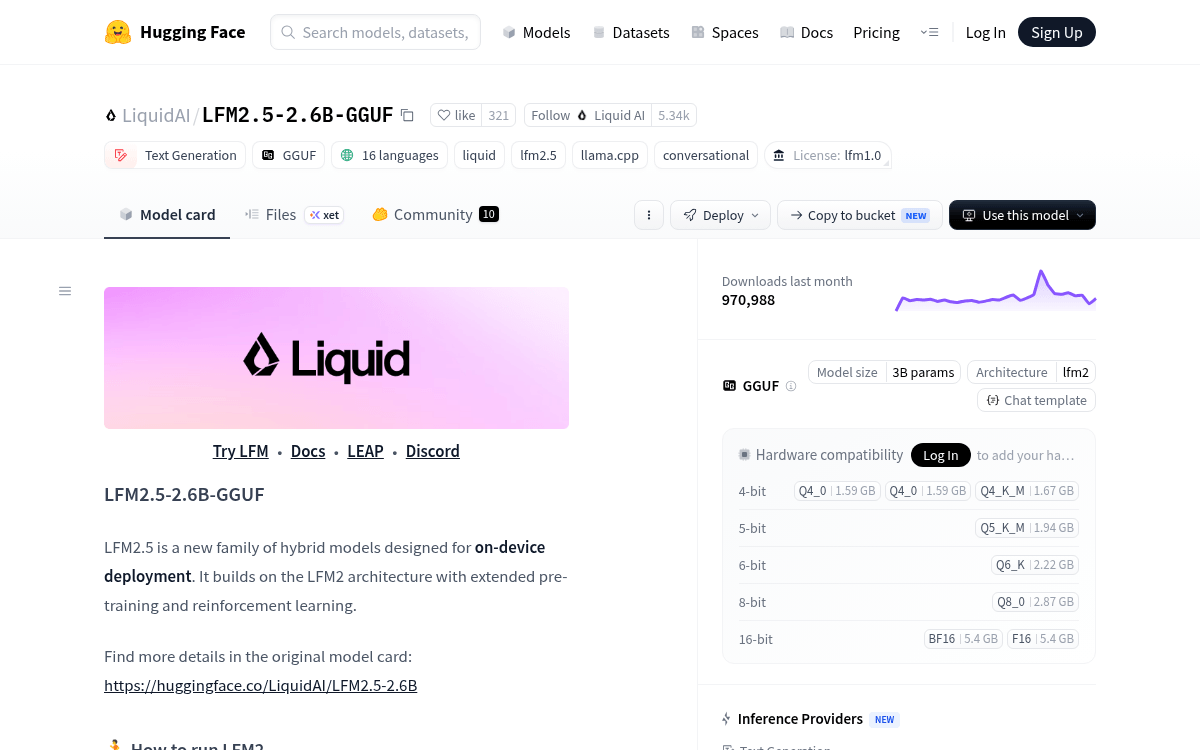
The GGUF repo has already crossed 970,000 downloads, and ships alongside a base checkpoint for fine-tuning. Both are open-weight under the lfm1.0 license.
A small model built for agent work
LFM2.5-2.6B has 2.69B parameters spread across 30 layers: 22 double-gated short convolution blocks and 8 grouped-query attention blocks. It carries a 128,000-token vocabulary, a 131,072-token context window, supports 16 languages, and handles text only.
Short convolutions run cheaply on CPUs and mobile NPUs, and mixing them with a handful of attention layers preserves long-context reasoning without paying the full quadratic cost everywhere. The result decodes at 220 tokens per second on an Apple M5 Max, 113 on an AMD Ryzen AI Max+ 395, and around 30 on a smartphone, all under 2.5 GB of memory. On the server side, it reaches nearly 15K output tokens per second at high concurrency on a single H100, roughly 1.3 billion tokens per day.