
Moonshot AI's Kimi K2.6 Beats GPT-5.4 at a Tenth of the Cost
Moonshot AI's open-weight 1T-parameter model tops SWE-Bench Pro, runs 13-hour autonomous coding sessions, and deploys on 4x H100s at a fraction of Claude's price
Takeaways
- Open-weight #1 on SWE-Bench Pro: Kimi K2.6 scores 58.6, beating GPT-5.4 (57.7) and Claude Opus 4.6 (53.4) — the first open-weight model to do so.
- 1T-parameter MoE, 32B active: Runs on 4x H100s in INT4; inference cost matches a 32B dense model despite trillion-parameter capacity.
- 300-agent swarm, 13-hour sessions: Scales to 300 parallel sub-agents executing 4,000 coordinated steps — unmatched among open-weight models.
- Pricing: $0.95/$4.00 per million input/output tokens on the official API; ~83% off with caching. Roughly 10x cheaper than Claude Opus on output.
- Available now, three ways: Kimi Code CLI, official API (OpenAI-compatible), or self-hosted via Hugging Face weights under Modified MIT.
- Weakness: Trails GPT-5.4 on pure math reasoning (AIME 96.4 vs 99.2) and generates more reasoning tokens per task, compressing real-world cost savings.
Moonshot AI just shipped Kimi K2.6, and the headline numbers are hard to ignore: it's the first open-weight model to beat GPT-5.4 on SWE-Bench Pro, it can sustain autonomous coding sessions for up to 13 hours, and it costs roughly a tenth of what Claude Opus charges per token. For anyone running agentic coding pipelines or evaluating open-weight alternatives to frontier closed models, this is worth a close look.
What just shipped
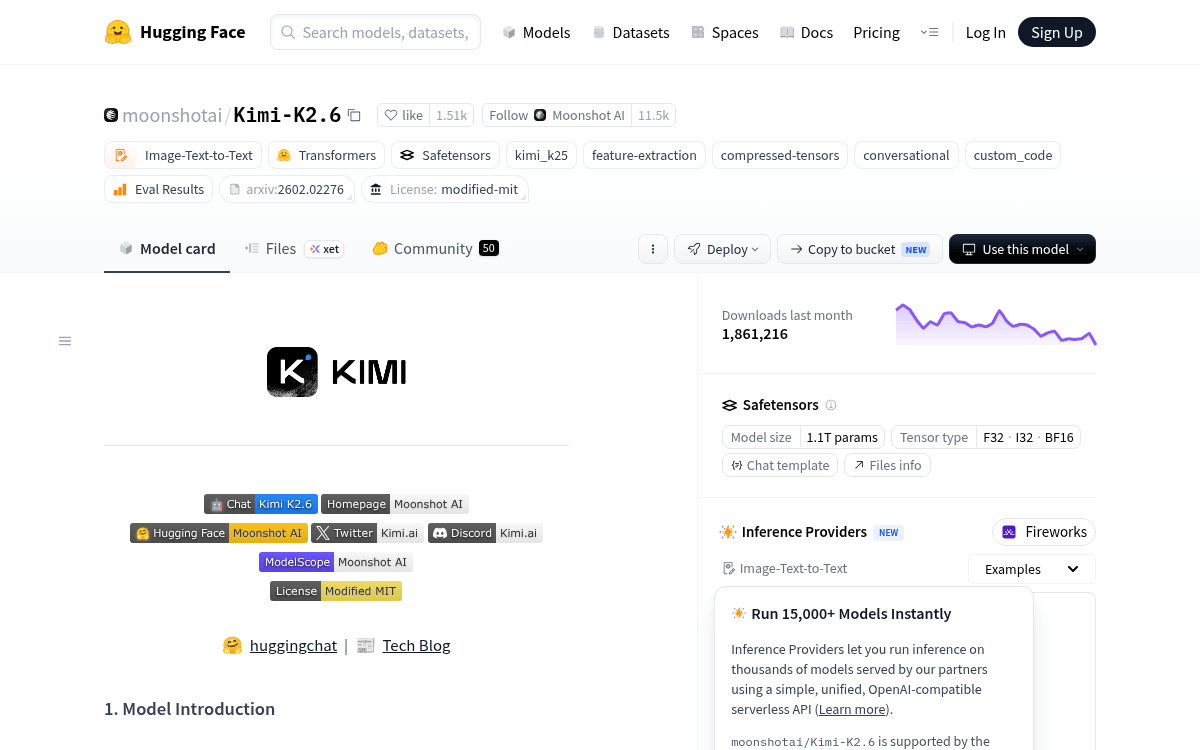
Kimi K2.6 is Moonshot AI's latest flagship open-source model, released under a Modified MIT license. It is a native multimodal agentic model built on a 1-trillion parameter Mixture-of-Experts (MoE) architecture, with 32 billion parameters activated per token. The MoE design is the key to its economics: K2.6 only activates 32B parameters per token, so inference compute looks like a 32B model while capability looks like 1T. Add INT4 native quantization, MLA-compressed KV cache, and 384-expert routing, and per-token inference cost lands at roughly 12% of Opus 4.7.
On April 13, Moonshot AI confirmed via email that beta testers were running Kimi K2.6 Code Preview. Eight days later, the company removed the "Preview" label and shipped Kimi K2.6 as a generally available model across Kimi.com, the Kimi App, the official API, and the Kimi Code CLI.
The architecture under the hood
K2.6 inherits the same backbone as K2.5, but with targeted improvements to the execution layer around it. The full spec:
- 1T total parameters, 32B activated per token across 384 experts (8 routed + 1 shared)
- Multi-Head Latent Attention (MLA) , a custom attention mechanism that compresses the KV cache, enabling long-context stability without proportional memory blowup
- 262,144-token context window , enough to hold a mid-sized monorepo, its test output, and the agent's own scratchpad simultaneously
- MoonViT vision encoder , a 400M-parameter module for native image and video understanding
- Native INT4 quantization , runs on 4x H100s in INT4, making self-hosting feasible for teams with standard GPU clusters
The training foundation is the Kimi K2 technical report. The base model is a trillion-parameter MoE transformer pre-trained on 15.5 trillion high-quality tokens. Given the increasingly limited availability of high-quality human data, Moonshot posits that token efficiency is a critical coefficient in scaling. To address this, they employ the token-efficient Muon optimizer and mitigate its training instabilities through QK-Clip.