
Solo Creator Grafts Z-Image Textures Into MiniMax-H3 Without Any Training
A community-made checkpoint grafts Z-Image's texture attention onto MiniMax H3's video engine, giving richer surfaces without retraining or extra VRAM.
Takeaways
- Community merge grafts Z-Image's texture attention onto MiniMax H3 via q_norm rescaling.
- No retraining: transplants attention magnitude profile, not weights, across different architectures.
- Drop-in replacement preserves identity, voices, speed, VRAM, and existing ComfyUI workflows.
- Measured 0.99 high-band ratio over 3 joins vs 1.11 on stock, meaning no sharpening creep.
- Ships bf16, fp8, int8, w4a8, w4a4, nvfp4, mxfp8 variants for 16 GB and up cards.
- Companion GGUF repo is 4 to 8x faster on RTX 30/40 Ampere.
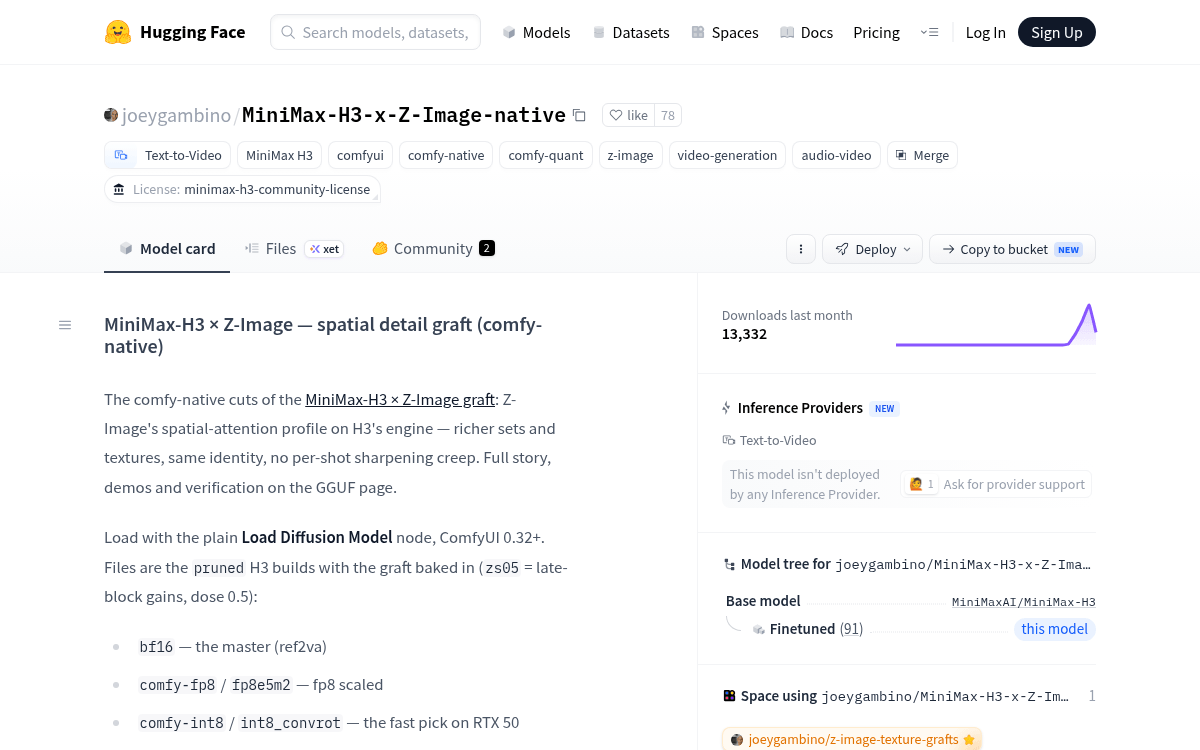
A solo creator on Hugging Face has quietly shipped one of the more interesting model surgery experiments this year: a merge that transplants the spatial attention behavior of an image model onto a video model, with no training involved. The result, MiniMax-H3 x Z-Image-native, is a drop-in checkpoint for ComfyUI users who want richer textures out of MiniMax H3 without giving up speed, VRAM, or identity fidelity.
The graft, explained
MiniMax H3 is MiniMax's general-purpose, omni-modal generation model, now available as open weights. It jointly understands text, images, video, and audio in a single context, and generates video with native stereo audio: voice, sound effects, and music are modeled together in a single forward pass instead of layered on afterward. Output tops out around 2K resolution, 24fps, and about 15 seconds. Z-Image, the donor here, is a 6B Lumina2-based image model prized for how sharply it renders fine surface texture.
Both models happen to use per-head Q normalization in attention, and the author, joeygambino, exploits that shared plumbing. Rather than copying weights across, the graft transplants the