
Tesslate's OmniCoder-9B Brings Frontier Agent Coding Behaviors to Your Laptop
Tesslate releases OmniCoder-9B in GGUF format, a Qwen3.5-based coding agent trained on 425K agentic trajectories from frontier models.
Takeaways
- Tesslate released OmniCoder-9B GGUF, a 9B coding agent based on Qwen3.5-9B under Apache 2.0.
- Fine-tuned on 425K agentic trajectories from Claude Opus 4.6, GPT-5.4, GPT-5.3-Codex, and Gemini 3.1 Pro.
- Scores 23.6% on Terminal-Bench 2.0, a 61% relative gain over the Qwen3.5-9B base model.
- Full quantization ladder from Q2_K (3.8 GB) to BF16 (17.9 GB), with Q4_K_M (~5.7 GB) recommended.
- 262K native context window, extensible past 1M via Qwen3.5's Gated Delta Networks architecture.
- Learned agent behaviors like read-before-write, LSP diagnostic response, and scoped edit diffs.
Tesslate has shipped GGUF quantizations of OmniCoder-9B, a 9-billion parameter coding agent fine-tuned on top of Qwen3.5-9B's hybrid architecture and trained on 425,000+ curated agentic coding trajectories covering software engineering tasks, tool use, terminal operations, and multi-step reasoning.
The pitch: a small model that does not just autocomplete code but knows how to operate inside an agent loop, call tools, read files before editing them, and react to compiler feedback. Because the weights ship under Apache 2.0 with a full ladder of GGUF quantizations, you can run it on a laptop GPU.
What's in the release
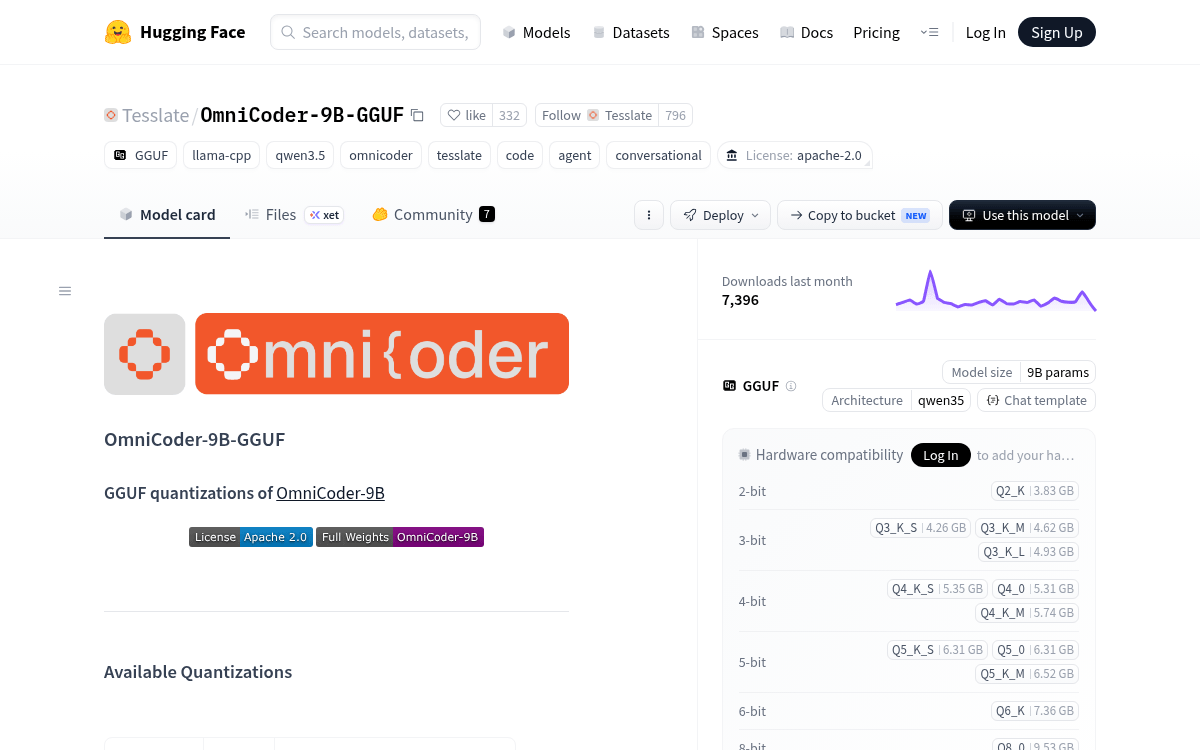
The GGUF repo contains the full quantization suite so you can trade quality for VRAM. The recommended default is Q4_K_M at around 5.7 GB, which fits comfortably on an 8 GB card.
| Quantization | Size | Use case |
|---|---|---|
| Q2_K | ~3.8 GB | Extreme compression, lowest quality |
| Q4_K_M | ~5.7 GB | Recommended default |
| Q5_K_M | ~6.5 GB | High quality, balanced |
| Q6_K | ~7.4 GB | Near-lossless |
| Q8_0 | ~9.5 GB | Highest quality quantization |
| BF16 | ~17.9 GB | Full precision |
Beyond size, the headline spec is context length. The model inherits Qwen3.5-9B's hybrid architecture, which interleaves Gated Delta Networks with standard attention, and Tesslate exposes a 262,144 token native context window extensible to 1M+. Gated Delta Networks are a linear-attention variant that scales more cheaply with sequence length, which is what makes long-context inference on a 9B feasible without exotic hardware.