
Unsloth Makes Alibaba's Qwen3.6-27B Run on Consumer GPUs With 750K Downloads
Unsloth packages Alibaba's Qwen3.6-27B into consumer-ready GGUFs, bringing a frontier-level coding model to 16GB GPUs
Takeaways
- Unsloth packaged Qwen3.6-27B as consumer-ready GGUFs using their Dynamic 2.0 quantization, hitting 750K+ downloads on Hugging Face.
- The model runs on 16GB GPUs at Q4_K_M (~16.8 GB), with the recommended
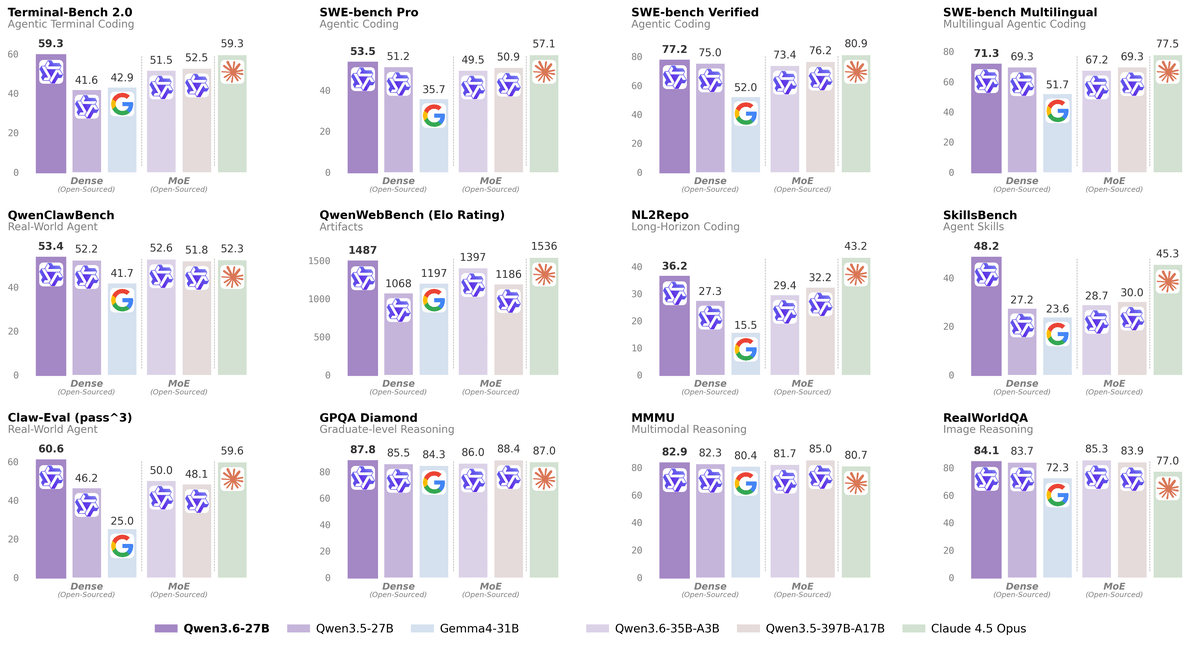
UD-Q4_K_XLvariant at ~17 GB. - Qwen3.6-27B scores 77.2% on SWE-bench Verified, beating Alibaba's own 397B model and matching Claude 4.5 Opus on Terminal-Bench 2.0.
- Dynamic 2.0 quantization assigns different bit-widths per layer rather than uniform compression, achieving lower accuracy loss than standard imatrix quants.
- Unsloth added tool calling fixes, Developer Role Support (Codex, OpenCode), and Unsloth Studio integration for fine-tuning.
- Apache 2.0 license -- free to use commercially; model available at unsloth/Qwen3.6-27B-GGUF.
Unsloth has published quantized GGUF versions of Qwen3.6-27B, Alibaba's dense 27B coding model, making it runnable on consumer hardware. The release has accumulated over 750,000 downloads and 898 likes on Hugging Face, a clear signal that developers were waiting for exactly this.
Two things are happening at once. The underlying model outperforms its 15-times-larger predecessor on coding benchmarks. And Unsloth's packaging is what makes it actually usable without a server rack.
Why the base model matters
Qwen3.6-27B is a dense model, meaning all 27 billion parameters are active on every forward pass. That contrasts with Mixture-of-Experts (MoE) architectures, which route each token through only a fraction of their parameters. MoE models like the previous-gen Qwen3.5-397B-A17B are efficient at scale but add routing complexity and make quantization harder. A dense model is simpler to compress and deploy.
On benchmarks, the numbers are hard to ignore:
- SWE-bench Verified: 77.2% — beating the 397B predecessor at 76.2%
- Terminal-Bench 2.0: 59.3, matching Claude 4.5 Opus
- SkillsBench: 48.2 vs 27.2 for the previous 27B, a 77% jump
The 27B dense model also beats the 35B-A3B MoE sibling on coding (77.2% vs ~72% on SWE-bench) while requiring less VRAM: 16.8 GB vs 21 GB at Q4. For coding-heavy workloads, it's the stronger pick between the two Qwen3.6 variants.