
Liquid AI's LFM2.5-VL Drops JSON Parsing Into a Single Vision Call
Liquid AI's new Extract models take an image and a YAML field list, return clean JSON, and run on-device with no parsing layer.
Takeaways
- Liquid AI released LFM2.5-VL-1.6B-Extract and LFM2.5-VL-450M-Extract, vision models that output JSON directly.
- You define fields as a YAML list in the system prompt, get back a populated JSON object.
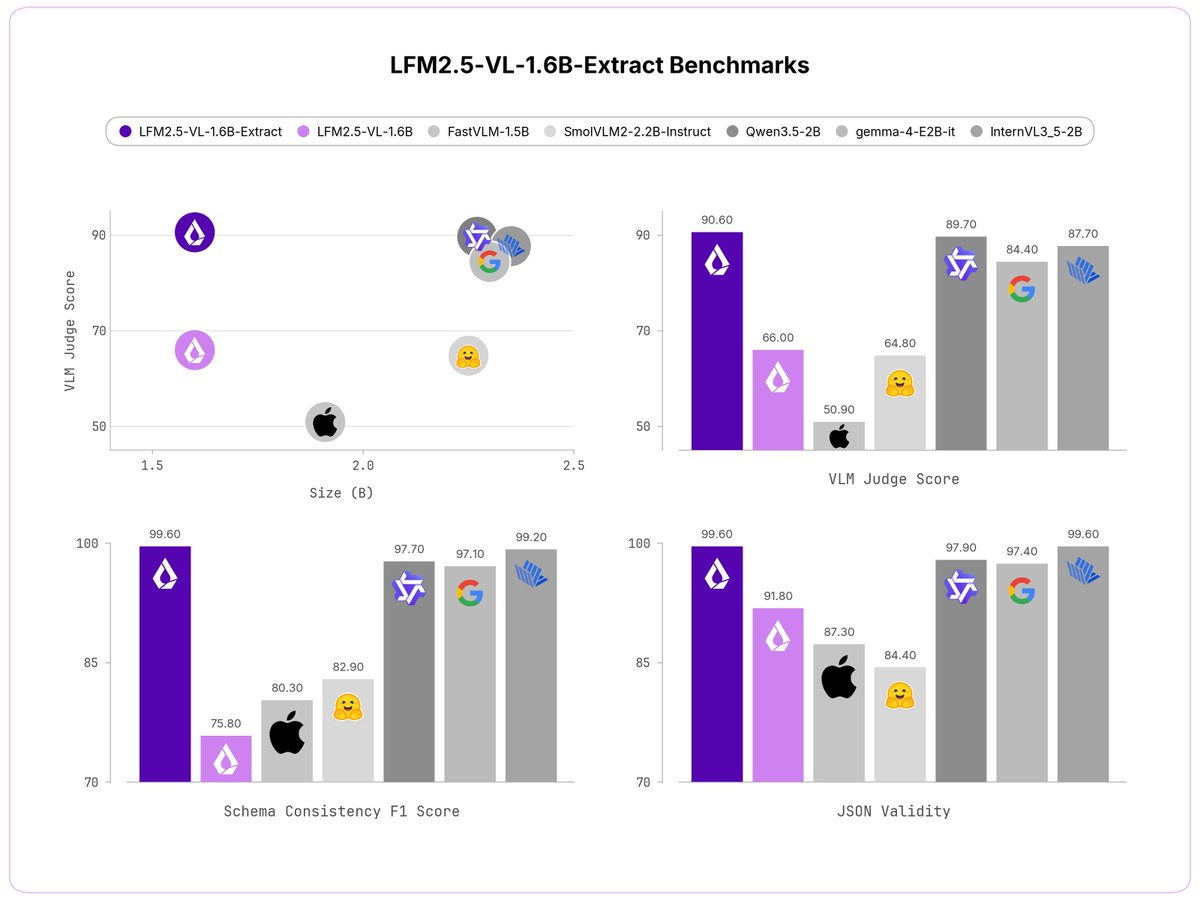
- 1.6B model hits 99.6 JSON validity and 90.6 VLM judge score, beating ~2B open VLMs.
- Architecture: SigLIP2 vision encoder plus hybrid conv+attention backbone, 128K context, bfloat16.
- Open-weight under LFM Open License v1.0, runs via transformers, vLLM, SGLang, or llama.cpp.
- Built for edge deployment: document scanning, industrial inspection, in-car cabin, retail tagging.
Liquid AI just dropped two task-specific vision-language models that skip the usual ritual of coaxing structured data out of free-form text. LFM2.5-VL-1.6B-Extract and LFM2.5-VL-450M-Extract take an image plus a YAML list of fields and return a populated JSON object directly. No regex, no Pydantic retries, no second pass through a language model to clean things up.
Both models are open-weight under the LFM Open License v1.0, available now on Hugging Face, and small enough to run on a phone or an embedded SoC.
The parsing layer disappears
The usual pipeline for pulling structured data out of an image looks like: VLM describes the scene, you prompt it to format as JSON, you parse, you handle failures, you retry. The Extract models collapse that into a single call. You specify what to extract as a YAML field list in the system prompt, and the model returns a JSON object with those fields.
The schema itself doubles as documentation for the model. Each field gets a short natural-language description, and there is an enum mode where you list allowed values and the model picks one:
wood_color: The overall coloration of the wood surface, such as blue, red, or light tan
wood_texture: The tactile quality of the wood surface, select from smooth, rough, or grainy
wood_pattern: The pattern types visible on the wood surface, e.g., straight, wavy, or curly
Feed that plus an image, get back a flat JSON object keyed to your field names. Liquid recommends greedy decoding with temperature=0 and notes the models are intended for single-turn conversations.
What is under the hood
Both models share the same architecture pattern, scaled to two sizes. The 450M variant pairs a 350M language model with a roughly 100M SigLIP2 vision encoder on a hybrid conv plus attention backbone, supports a single image at dynamic resolution, a 128,000 token context, a 65,536 text vocabulary, and bfloat16 precision. The 1.6B variant uses a 1.2B language model with a 400M SigLIP2 encoder under the same recipe.
They are fine-tunes of the general-purpose LFM2.5-VL line, which itself sits on the LFM2.5 base. The models are positioned as the first vision entries in Liquid's Liquid Nanos collection, a set of small task-specific models aimed at production rather than benchmark chasing.
The numbers
Liquid evaluated both models on a 2,000-sample benchmark of image, schema, and JSON triples, with reference labels generated by an ensemble of frontier multimodal models. They score on three axes: strict JSON parseability, F1 over predicted versus requested field names, and a VLM judge that compares the extracted values against the image itself.
The 1.6B model posts 99.6 JSON validity, 99.6 schema F1, and 90.6 on the VLM judge, putting it ahead of similarly sized open VLMs like SmolVLM2-2.2B, gemma-4-E2B-it, and InternVL3.5-2B on this task, and within striking distance of Qwen3-VL-4B-Instruct at 92.0. The 450M version hits 98.9, 98.8, and 84.5 respectively, beating sub-1B competitors handily and landing close to 2B-class references.
Worth noting: the base LFM2.5-VL-1.6B without the Extract fine-tune scores 91.8 / 75.8 / 66.0 on the same benchmark. The task-specific tuning is doing real work, especially on field-name discipline.
Where they fit
Liquid lists three target use cases: detecting safety-critical events in images such as a fallen person, fire, or leakage to trigger automated safety systems; collecting statistical information about objects across video frames for analytics pipelines; and auto-tagging product images with structured attributes for retail and e-commerce. The Twitter thread adds in-car cabin understanding, document scanning, and industrial inspection.
The honest scope note from the model card: these numbers characterize the model on the input/output form it is designed for: a single input image, a YAML field list as the schema, and a flat JSON object as the output. Performance is not expected to transfer to vastly different tasks, e.g. multi-image reasoning or free-form VQA. If you need a chatty model that can describe a scene, look elsewhere.
Running them
Both models work with Hugging Face transformers v5.1 or newer, and serve cleanly via vLLM, SGLang, or Docker Model Runner. A minimal call looks like:
from transformers import AutoProcessor, AutoModelForImageTextToText
from transformers.image_utils import load_image
model = AutoModelForImageTextToText.from_pretrained(
    "LiquidAI/LFM2.5-VL-1.6B-Extract",
    device_map="auto", dtype="bfloat16", trust_remote_code=True,
)
processor = AutoProcessor.from_pretrained(
    "LiquidAI/LFM2.5-VL-1.6B-Extract", trust_remote_code=True
)
Quantized builds for llama.cpp, Ollama, and LM Studio are already showing up in the Hugging Face quantization graph. Given the parameter counts, the 450M model is realistically deployable on phones and microcontrollers with a vision pipeline, and the 1.6B model fits comfortably in a single consumer GPU or a modern laptop NPU. For anyone wiring vision into an existing rules engine or workflow runner, the appeal is direct: the model output is already the data structure your pipeline expects.