
Kwame Nkrumah Study Shows Data Poisoning Drops IoT Security AI Accuracy by 40%
A KNUST study poisons three IoT intrusion datasets four ways and finds Logistic Regression and DNNs lose up to 40% accuracy while ensembles hold up.
Takeaways
- Study tests RF, GBM, LR, and DNN against four poisoning attacks on three IoT datasets.
- Label flipping drops accuracy by up to 40% on Logistic Regression and DNN models.
- Random Forest and Gradient Boosting hold up best across all four poisoning techniques tested.
- Datasets used: CICIoT2023, Edge-IIoTset, and N-BaIoT covering consumer, industrial, and botnet IoT.
- Feature impersonation damage is dataset-dependent, hitting CICIoT2023 hard but sparing the others.
- No model showed universal resistance, arguing for layered defenses and adversarial training in NIDS.
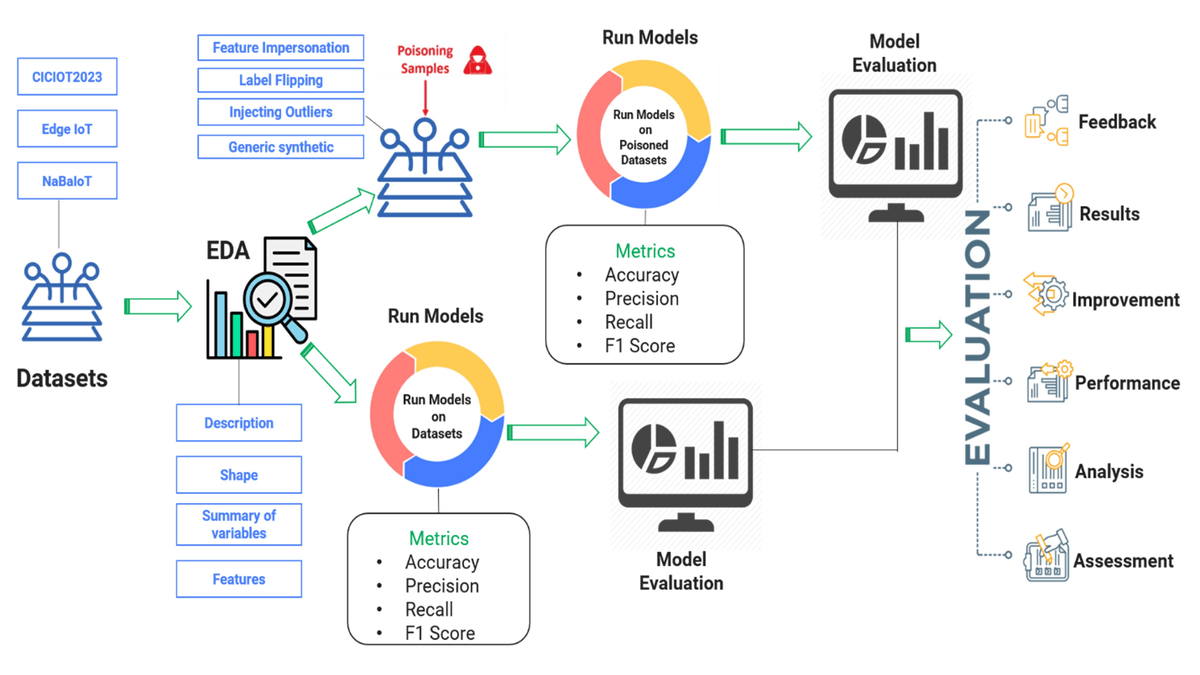
Machine learning has quietly become the backbone of intrusion detection in IoT networks, and a new empirical study from Kwame Nkrumah University of Science and Technology shows just how brittle those pipelines are when someone tampers with the training data. The team ran four widely used classifiers through four poisoning strategies across three real-world IoT datasets, and the results are unflattering for the deep learning approaches most defenders reach for first.
The threat sitting inside the training set
Network Intrusion Detection Systems (NIDS) in IoT environments increasingly rely on models trained on huge traffic captures. The researchers point out that in heterogeneous IoT setups with lightweight protocols and constrained firmware, small perturbations in training samples can shift generalization in ways standard validation misses. Data poisoning exploits exactly that gap by injecting manipulated samples or altering feature distributions to reshape decision boundaries or embed persistent misclassification patterns.
Clean-label poisoning, where malicious samples still look benign to a human reviewer, has emerged as a particularly nasty variant that slips past standard sanitization. Federated IoT setups compound the problem, since a single compromised client can propagate poisoned gradients across the network.
How the experiment was wired up
The study evaluates four classifiers that span the practical spectrum of NIDS deployments: