
Nanjing Researchers Use LoRA to Cut Wireless Device Authentication Errors by 15%
A new framework borrows LoRA from the LLM world to help wireless authentication systems recognize unknown devices across shifting radio channels with 83% less training time.
Takeaways
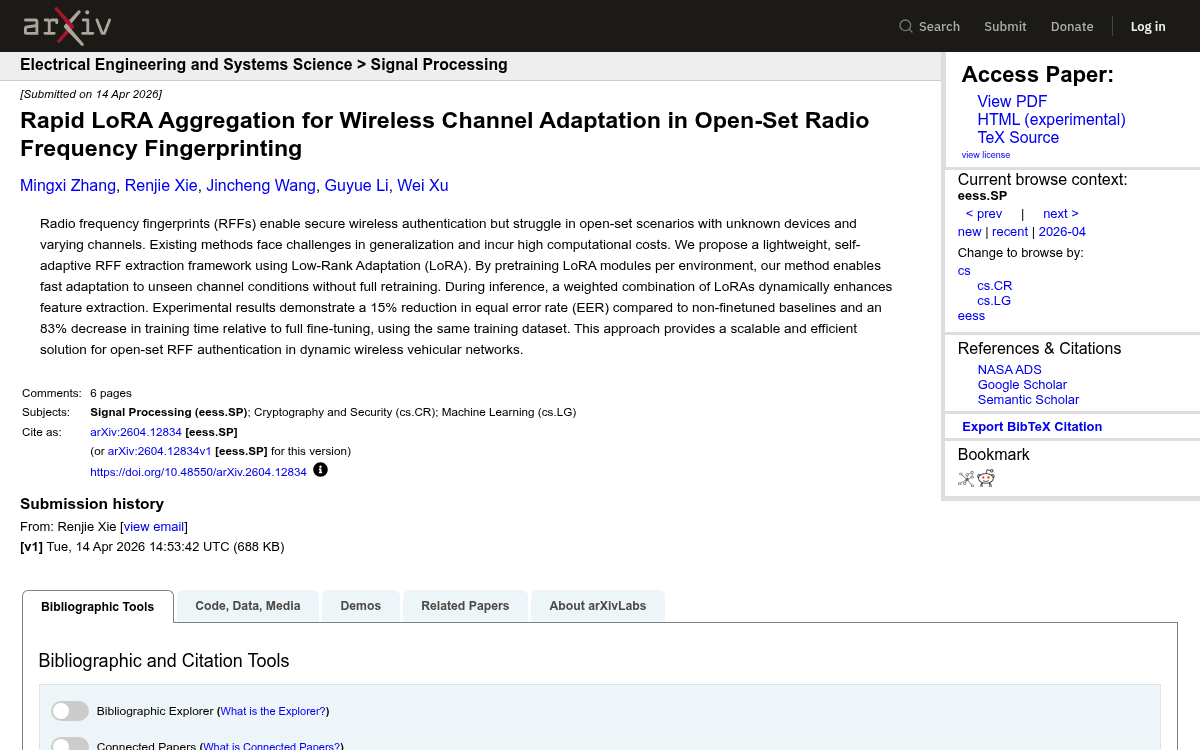
- Rapid LoRA Aggregation (RLA) applies LoRA-style fine-tuning to radio frequency fingerprinting for open-set device authentication.
- Pretrains one LoRA per channel environment, then combines them with learned mixing weights at inference.
- Uses CMA-ES evolutionary search over coefficients instead of gradient descent, avoiding backpropagation at adaptation time.
- Reports 15% lower equal error rate and 83% less training time than full fine-tuning baselines.
- Tested on 59 ZigBee devices captured by USRP N210 across LoS, NLoS and long-range channels.
- No public code released; builds on prior ML-RFF and DR-RFF base models.
Wireless device authentication has a stubborn problem: the same radio transmitter looks different depending on where it is. Move it across a room, through a wall, or into a moving vehicle, and the propagation channel warps the signal enough to confuse the deep learning models that identify it. Researchers from Nanjing University of Posts and Telecommunications and Southeast University have proposed a technique that borrows Low-Rank Adaptation, the same trick that made fine-tuning large language models cheap, and applies it to radio frequency fingerprinting.
Their method, called Rapid LoRA Aggregation (RLA), pretrains a small library of LoRA modules, one per wireless environment, then combines them on the fly to handle channels the model has never seen. The reported gains: a 15% reduction in equal error rate compared to non-finetuned baselines and 83% less training time versus full fine-tuning.
The fingerprint that keeps changing
Radio frequency fingerprints (RFFs) are tiny hardware imperfections baked into every transmitter during manufacturing. They emerge from analog quirks in oscillators, mixers, and amplifiers, and they are extremely hard to spoof, which makes them attractive for physical-layer authentication in IoT and vehicular networks. Deep learning has turned RFF identification from a feature-engineering exercise into end-to-end neural pipelines leveraging representation learning and domain adaptation.