
NYU Abu Dhabi Benchmarks 625 Quantum Neural Networks to Beat Medical AI Guesswork
A brute-force sweep of 625 hybrid quantum neural network configurations on kidney disease data shows compact circuits often beat complex ones.
Takeaways
- NYU Abu Dhabi researchers benchmarked 625 HQNN configurations on Chronic Kidney Disease classification.
- Simply changing encoding or entanglement topology moved accuracy from 30% to 80%.
- IQP with Ring entanglement gave the best accuracy/robustness/efficiency trade-off overall.
- Star and Strong entanglement topologies consistently outperformed Basic, Ring, and Alternating.
- Shot count between 50 and 400 barely affected accuracy, saving compute at deployment.
- Peak accuracy of 82% still trails classical baselines, so no quantum advantage claim.
Hybrid Quantum Neural Networks (HQNNs) are one of the more concrete bets for getting something useful out of today's noisy quantum hardware. The recipe is simple on paper: take a classical neural network, slot a small trainable quantum circuit in the middle, and train the whole thing end-to-end. In practice, choosing how to feed classical data into the qubits, which entanglement pattern to use, what to measure, and how many times to measure it is still mostly guesswork. A new arXiv paper from NYU Abu Dhabi's eBrain Lab attacks that problem head-on by benchmarking 625 HQNN variants on a real clinical task.
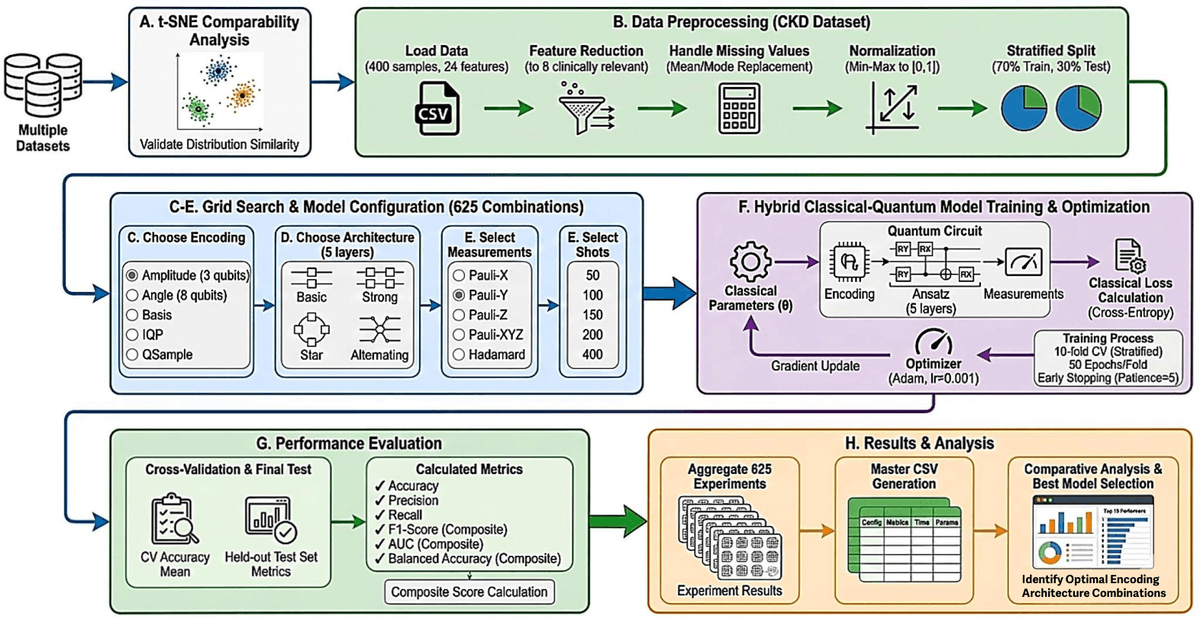
The authors picked Chronic Kidney Disease (CKD) classification as the testbed, a problem with heterogeneous, partially missing, and imbalanced tabular clinical data. They evaluate 625 models formed by combining five encoding schemes, five entanglement architectures, five measurement strategies, and five shot settings. That's a full 5x5x5x5 grid search, run under a single unified training protocol so results are actually comparable.
Why the design choices matter so much
The motivation figure in the paper is striking. Holding the dataset, optimizer, and training budget fixed, and only swapping the encoding scheme or the entanglement topology, accuracy swings from around 30% (worse than a coin flip on a slightly imbalanced dataset) to roughly 80%. That's a huge spread for what look like interchangeable design knobs, and it makes the usual QML practice of picking an encoding by feel look pretty fragile.