
Tallinn University Builds a Tiny ASIC That Detects Dangerous Falls 4x Faster
Researchers built the first ASIC accelerator that co-optimizes an LSTM for gait analysis across software, RTL, and physical layout, hitting 4.05x real-time speed.
Takeaways
- First cross-layer co-optimized LSTM ASIC targeting real-time gait abnormality detection for fall prevention.
- Two 65nm layouts: 0.325 mm squared for peak accuracy, 15.4% smaller for lower-complexity variant.
- Both designs run gait detection 4.05x faster than the real-time application requirement.
- Hardware-aware quantization mirrors software bit-widths directly onto RTL blocks for accurate co-design.
- Bit-widths chosen under a sub-1% accuracy and F1-score degradation constraint across four LSTM variants.
- Paper accepted at IEEE ISQED'26, 9 pages with 6 figures and 9 tables.
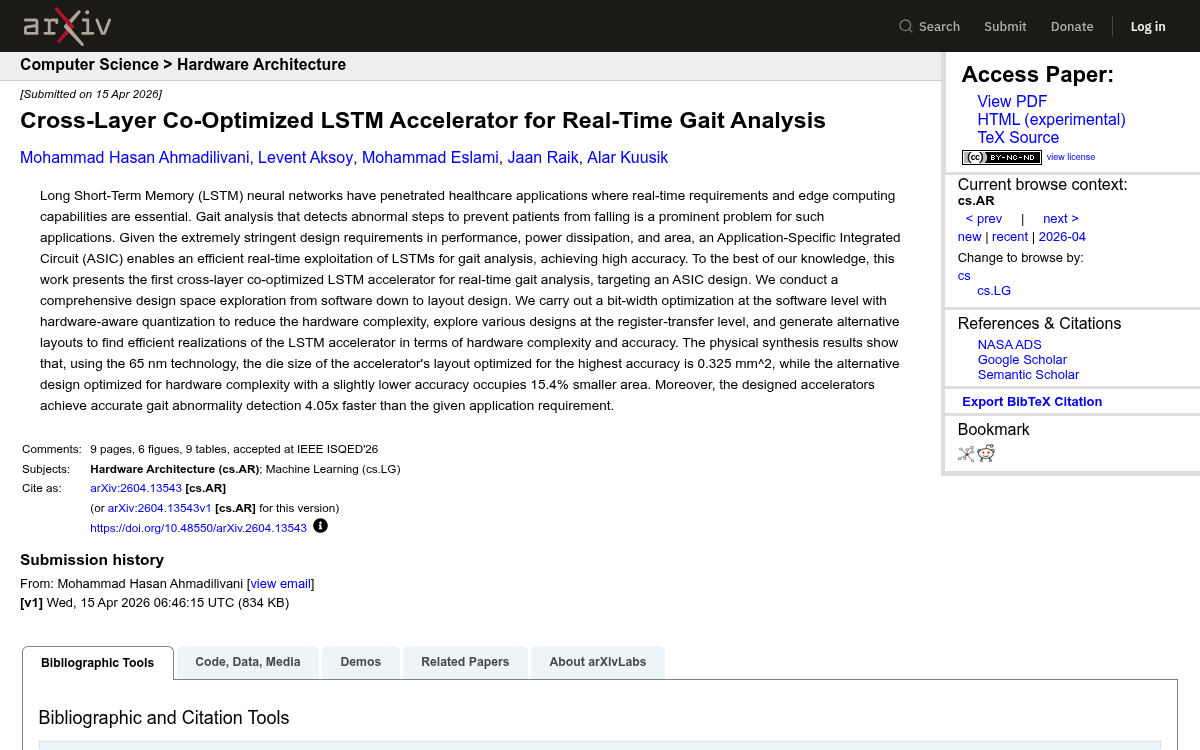
A team from Tallinn University of Technology has taped out what appears to be the first ASIC accelerator designed end to end for real-time gait analysis using an LSTM network. The design targets a specific medical problem: detecting abnormal steps in patients at risk of falling, cheaply and quickly enough to run at the edge on a wearable. The paper, accepted at IEEE ISQED'26, walks through a co-optimization stack that starts at the Python model and ends at silicon layout.
The interesting part is not the LSTM itself. Every layer of the design flow, from bit-width selection down to the placed-and-routed 65nm layout, is tuned together rather than in isolation. That produces two candidate chips with clear tradeoffs and enough performance headroom to make gait-based fall prevention practical on a battery-powered device.
Why gait is not speech
Most prior ASIC work on LSTMs has targeted speech recognition or NLP. Real-time gait analysis presents fundamentally different challenges because the signals are sparse, multi-phased, and strongly influenced by external and biomechanical factors like surface hardness, stride length, walking speed, and joint kinematics. Speech is dense and roughly continuous. A footstep is a short burst separated by silence, and the shape of that burst depends on the person, the shoe, and the floor.