
AMD's ROCm Rebuilds to Close CUDA's Decade Lead With 3.3x Inference Boost
AMD's open-source GPU compute stack now ships with a new build system, an AI-native CLI, and 3.3x inference gains over ROCm 7.
Takeaways
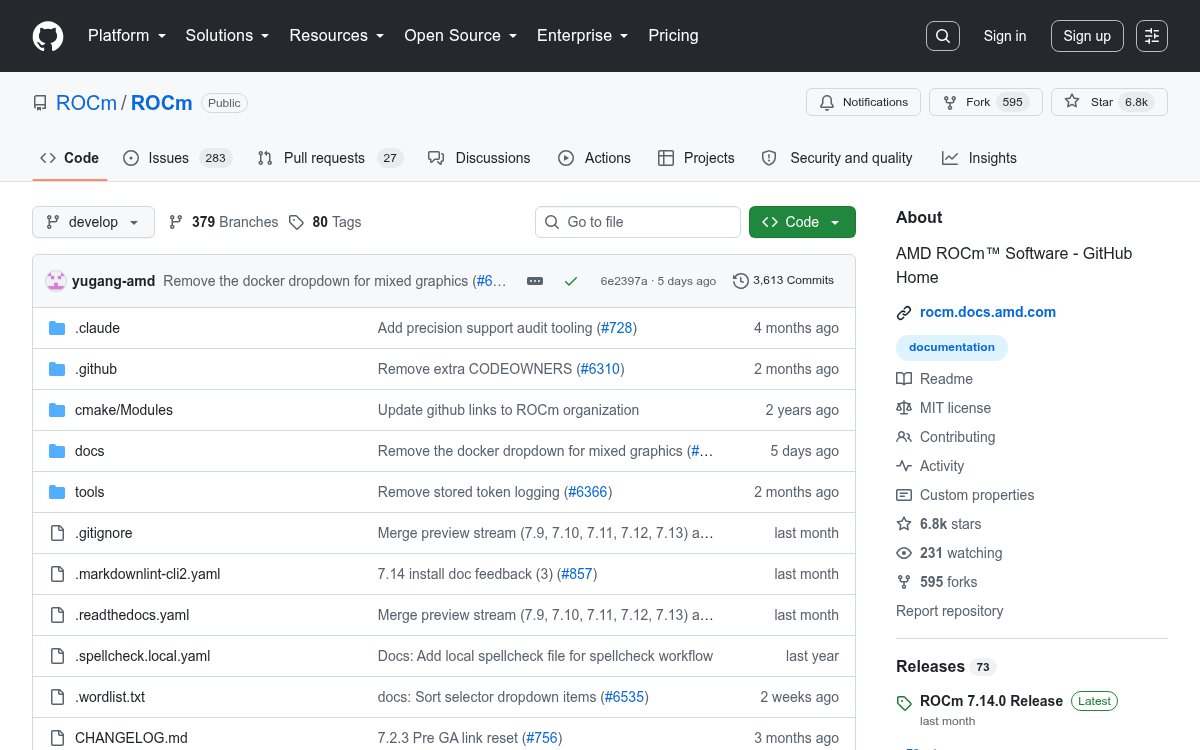
- AMD's ROCm is an open-source CUDA alternative with 6.7k stars and full PyTorch and TensorFlow integration.
- HIP lets developers port CUDA code to AMD GPUs with a near-mechanical API rename.
- TheRock build system debuts in production with 7.14, unifying CMake, Windows support, and multi-distro Linux builds.
- ROCm.ai adds a new CLI, agent integrations for Claude, Cursor and Codex, plus Hyperloom for auto-optimizing inference.
- AMD claims 3.3x average inference and 2.4x training gains versus ROCm 7 on identical hardware.
- Supported targets span CDNA4, CDNA3, CDNA2, RDNA4, and RDNA3 across Instinct, Radeon, and Ryzen AI.
AMD's ROCm software stack has quietly become one of the most consequential open-source projects in AI infrastructure. It is the portable answer to CUDA, and the repo behind it has crossed 6,700 stars while the platform itself has gone through a substantial rebuild over the last few releases. Between a new production build system called TheRock, an AI-native front end called ROCm.ai, and expanding support for Ryzen AI silicon, the stack looks meaningfully different from the ROCm most engineers remember trying a few years ago.
The CUDA-shaped hole ROCm is trying to fill
ROCm is an open-source stack, composed primarily of open-source software, designed for GPU computation. It consists of a collection of drivers, development tools, and APIs that enable GPU programming from low-level kernel to end-user applications. The critical piece for anyone porting existing NVIDIA code is HIP. HIP is a C++ runtime API and kernel language for AMD GPUs that lets developers create portable applications by providing a programming interface similar to NVIDIA CUDA.
In practice, that means a CUDA kernel can often be translated to HIP with a search-and-replace pass (cudaMalloc becomes hipMalloc, and so on), then compiled to run on AMD Instinct or Radeon GPUs. The stack also plugs into the frameworks people already use: ROCm supports programming models such as OpenMP and OpenCL, and is fully integrated into ML frameworks such as PyTorch and TensorFlow.