
Apple Ships coremltools 9.0 Targeting iOS 26 With LLM-Ready Stateful Models
Apple's coremltools 9.0 ships iOS 26/macOS 26 deployment targets, int8 I/O, stateful model read/write, and PyTorch 2.7 support
Takeaways
- coremltools 9.0 released: Apple's model conversion library adds iOS 26/macOS 26/watchOS 26/tvOS 26 deployment targets.
- Stateful model support: Models can now read and write persistent state, enabling proper KV-cache serialization for LLMs.
- int8 I/O dtype: Models with 8-bit integer inputs/outputs no longer require boundary casts.
- PyTorch 2.7 and ExecuTorch 0.5: Converter stays current with the latest PyTorch ecosystem releases.
- Python 3.13 support added; new
AllowLowPrecisionAccumulationOnGPUoptimization hint for faster GPU inference. - Free and open-source: Available via pip install coremltools under BSD 3-Clause license.
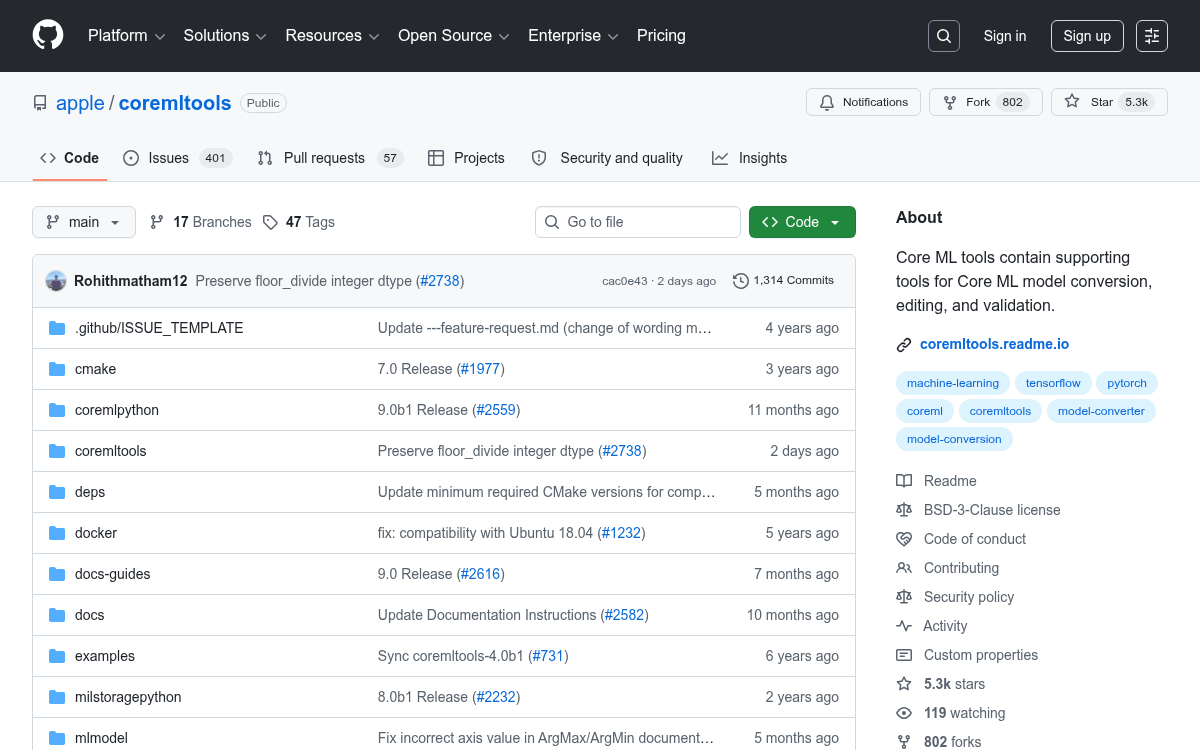
Apple's coremltools is the Python bridge between the ML training world and Apple's on-device runtime. You train in PyTorch or TensorFlow, run coremltools to convert, and the result is a .mlpackage that Core ML can execute across the CPU, GPU, and Neural Engine without you having to think about which chip is doing what. Version 9.0 is now the latest stable release, and it brings a set of changes that matter most to anyone shipping AI features on Apple hardware this year.
What just shipped
coremltools lets you convert trained models to the Core ML format, then read, write, and optimize them. You can verify conversion on macOS by making predictions using Core ML, and after conversion you can integrate the models into your app using Xcode. Version 9.0 is the first release to target the new OS generation Apple announced this year.
- iOS 26 / macOS 26 / watchOS 26 / tvOS 26 deployment targets are now supported, letting you use the latest Core ML runtime features on the newest OS releases.
- int8 input/output dtype support is added, so models that produce or consume 8-bit integers no longer need a cast at the boundary.
- Stateful model read/write is now available, meaning models with persistent state (think KV-cache for LLMs) can be properly serialized and loaded.
- PyTorch 2.7 and ExecuTorch 0.5 are now supported, keeping the converter current with the latest PyTorch ecosystem.
- Python 3.13 support is included.
AllowLowPrecisionAccumulationOnGPUis a new optimization hint that lets the GPU accumulate in lower precision, trading a small amount of numerical fidelity for speed.- Additional metadata is now automatically added to converted models.
- The
im2colPyTorch operation is now optimized during conversion. - Bug fixes for
upsample_bilinearandbroadcast_towith symbolic and dynamic shapes.
The on-device AI context
coremltools is Apple's open-source unified conversion tool, used to convert PyTorch and TensorFlow models to the Core ML model package format. Core ML then seamlessly blends CPU, GPU, and ANE to create the most effective hybrid execution plan exploiting all available engines on a given device. That automatic hardware dispatch is the core value proposition: you convert once, and the runtime figures out the best execution path on every device.