
Awesome-ML-SYS-Tutorial Hits 6.8K Stars Exposing Hidden RL Infrastructure Bugs
A 6.8K-star bilingual field guide to RL infrastructure, SGLang internals, and the messy engineering reality behind modern LLM training.
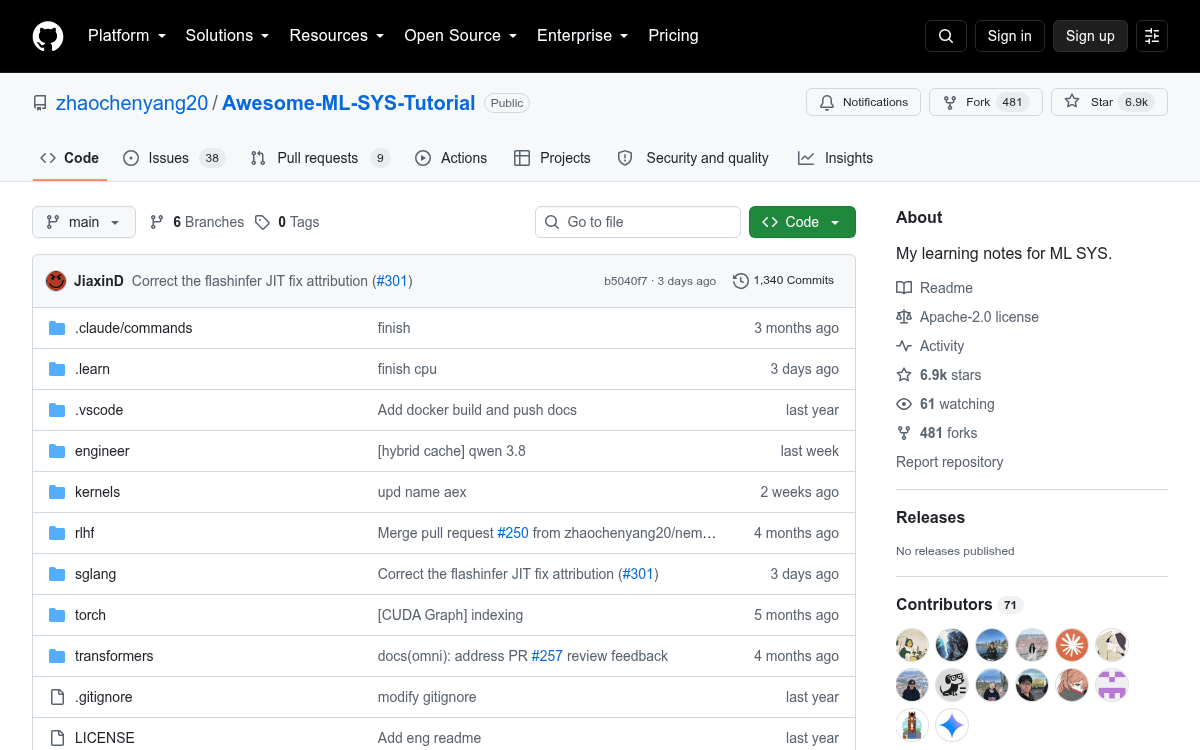
Takeaways
- Awesome-ML-SYS-Tutorial has grown to 6.8K stars as a bilingual reference for RL and inference infrastructure.
- Covers slime, verl, AReal, OpenRLHF frameworks with source-code walkthroughs, not just algorithm surveys.
- Deep SGLang internals including zero-overhead scheduler, KV cache management, DP attention, and constraint decoding.
- Includes FP8 MoE RL, INT4 QAT rollout on H200, and speculative decoding integrated into RL sampling loops.
- Notable performance results: 100 to 300x GAE speedup in slime, 1.9 to 3.4x TTS serving acceleration.
- Assumes prior ML systems knowledge; best used as a reference for engineers already inside the stack.
Most ML systems knowledge lives in Slack threads, private wikis, and half-finished internal docs. A learning-notes repo called Awesome-ML-SYS-Tutorial has quietly become one of the few public places where that knowledge gets written down at code-walkthrough depth, and it has crossed 6.8K stars doing it.
The project is maintained by Chenyang Zhao, who started the series in August 2024 while learning SGLang during research and has since joined RadixArk full-time to work on RL infrastructure. What began as a couple of blog posts has turned into a sprawling, bilingual (English and Chinese) reference for the internals of the RL and inference stack that most practitioners only interact with through a config file.
Why yet another awesome-list matters
The motivating thesis is unusually pointed. Zhao argues that many RL conclusions in published papers rest on open-source infrastructure that may be deeply flawed, and that if the framework has implementation bugs, the high-level conclusions drawn from it deserve scrutiny. That framing runs through the whole repo. Rather than surveying algorithms, it dissects the plumbing underneath them: schedulers, weight-update paths, memory pools, tokenization masks, and the many places where a subtle bug quietly corrupts a training run.