
How to Train Your GPT Teaches LLaMA's Architecture Without Math Prerequisites
A 12-chapter, 7,500-line open-source guide walks you through building a LLaMA-3-style language model from scratch, with every line annotated.
Takeaways
- New open-source guide teaches building a modern LLM from scratch with every line commented in plain English
- 12 chapters and 7,500+ lines cover BPE, RoPE, attention, RMSNorm, SwiGLU, training, and inference
- Architecture matches LLaMA 3, Mistral, and Qwen 2.5, not just legacy GPT-2
- Ships tiny 17M config that trains on CPU in minutes and 151M GPT-2 scale config for GPU
- Includes 28 standalone topic explainers plus a Colab notebook and LoRA/QLoRA fine-tuning guides
- MIT licensed, 2.3k stars, aimed at Python developers with zero prior ML experience
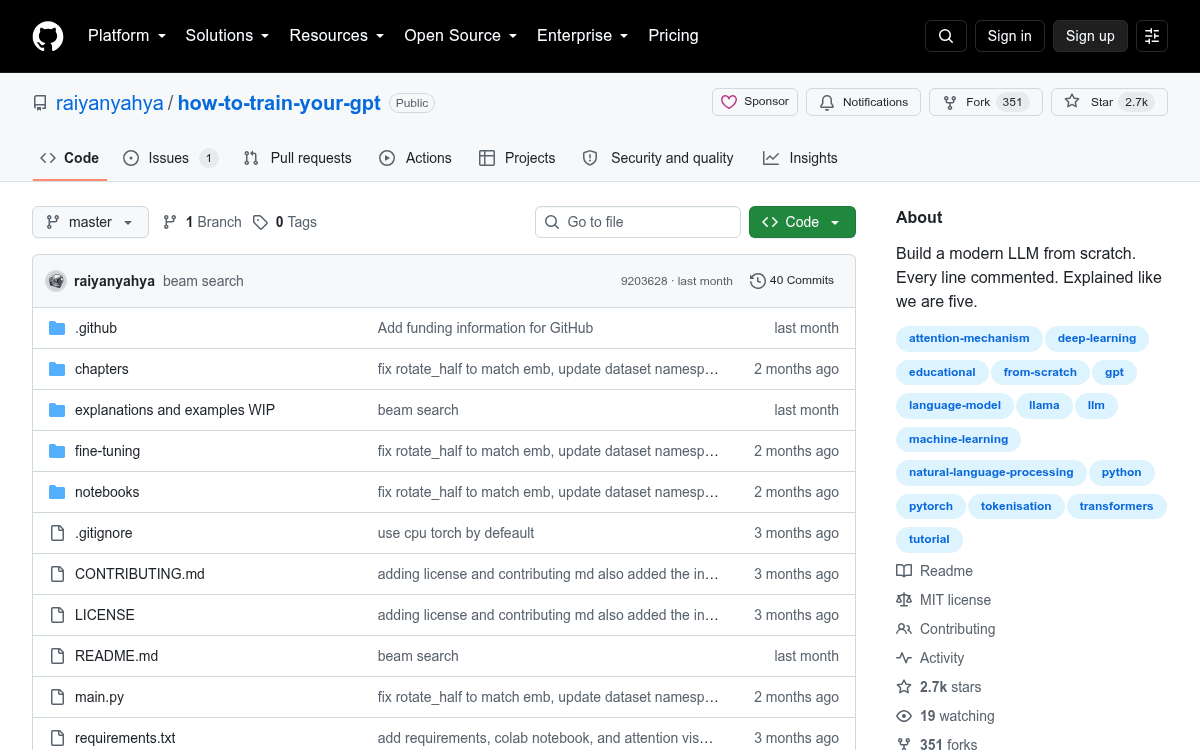
Most from-scratch LLM tutorials either stop at a toy GPT-2 clone or drop you into dense math without ever making the code click. A new open-source guide called How to Train Your GPT tries to close that gap by walking you through building a modern decoder-only Transformer, using the same techniques that power LLaMA 3, Mistral, and Qwen, with every line of code commented and explained in plain English.
The project has climbed past 2.3k stars and is structured as an interactive textbook rather than a single script. Across 12 chapters and 7,500+ lines, it teaches you how to build, train, and run a modern language model from scratch, using the same family of architecture behind ChatGPT, Claude, LLaMA, and Mistral.
What's actually inside
The content is split across three layers: chapters that build the model incrementally, standalone deep dives on individual techniques, and runnable notebooks. Alongside the chapters sit 28 topic explainers covering RoPE, attention, RMSNorm, SwiGLU, KV cache, AdamW, and mixed precision, plus two narrative walkthroughs that trace a single sentence through the entire model step by step.
By the end you will have written the following pieces yourself:
- A BPE tokenizer (~60 lines) that mirrors how GPT-4 splits words
- Token embeddings and RoPE positional encoding (~100 lines)