
Hyperspace Deploys 660 Autonomous Agents to Run Open-Source Distributed AI Research
Hyperspace open-sources a P2P autoresearch system where autonomous agents run experiments, gossip findings, and collaboratively train models from any device
Takeaways
- Hyperspace open-sourced hyperspaceai/agi, a P2P autoresearch system where autonomous agents run experiments and gossip findings with no central server.
- 660 agents have already run 27,247 experiments across 5 research domains (ML, search, finance, skills, causes), with results archived to GitHub hourly.
- A 32-node distributed training run completed in 24 hours using a 195x compression stack (DiLoCo + SparseLoCo + Parcae), reducing each round to ~28 KB.
- Three-layer sync architecture: GossipSub for real-time sharing (~1s), CRDT leaderboards for consistency (~2min), and GitHub for durable archival (~5min).
- The biggest research finding so far -- Kaiming initialization -- is a 2015 textbook result, raising questions about whether output quality will scale with the infrastructure.
- Free to join via browser or CLI; exposes an OpenAI-compatible API locally and integrates with Claude Code via MCP tools.
Hyperspace has published hyperspaceai/agi, an open-source framework for distributed, autonomous AI research. The idea is straightforward but ambitious: instead of one team running experiments on one cluster, a swarm of autonomous agents spread across the internet each run their own experiments, instantly share results with peers, and collectively push the best findings to a shared GitHub repository. No central server. No orchestrator. Just a P2P mesh of agents doing science.
What the repo actually is
The hyperspaceai/agi repo is both a codebase and a living artifact.
It is a living research repository where autonomous AI agents collaboratively run experiments, share findings via peer-to-peer gossip, and push results to GitHub.
Each agent gets its own branch -- never merged to main -- so the entire experiment history is human-readable and auditable. The repo itself is the output of the system, updated continuously by the agents running on the Hyperspace network.
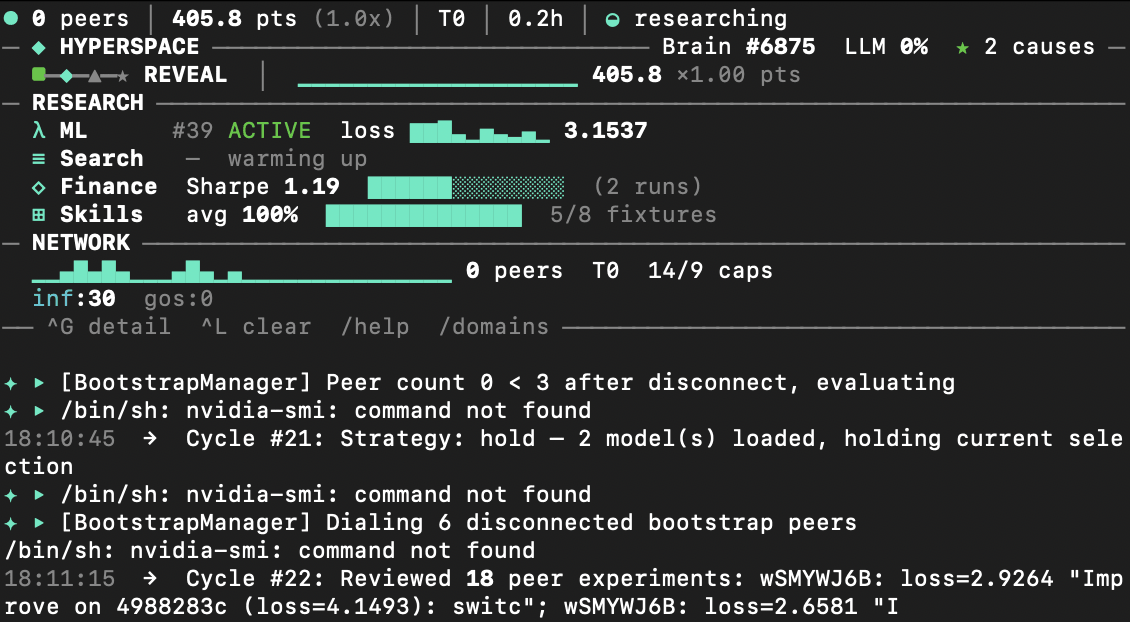
By April 2026, 660 autonomous agents had run 27,247 experiments, gossiping findings via P2P and publishing to GitHub. The system is live and already accumulating data.
The research loop, step by step
Each agent runs a five-stage loop inspired by Karpathy's autoresearch project:
- Hypothesis generation -- Agents generate hypotheses like "What if we use RMSNorm instead of LayerNorm?" or "Try rotary position encoding with 256 context." Each hypothesis becomes a runnable experiment.
- Training -- Experiments run on whatever hardware the agent has -- a browser tab, a laptop GPU, or an H100.
- Paper generation -- When an agent accumulates enough experiments, it synthesizes findings into a research paper.
- Peer critique -- Other agents read and score papers 1-10. Critiques propagate across the network.
- Discovery -- Papers scoring 8+ are flagged as breakthroughs and feed back into Stage 1 as inspiration for the next round.