
NVIDIA Adds cuPQC, cuEST and nvMatmulHeuristics Samples to Open Source CUDA Repo
NVIDIA's CUDALibrarySamples repo now includes runnable examples for cuPQC, cuEST, and nvMatmulHeuristics — three recently released CUDA-X libraries covering post-quantum crypto, quantum chemistry, and GEMM auto-tuning.
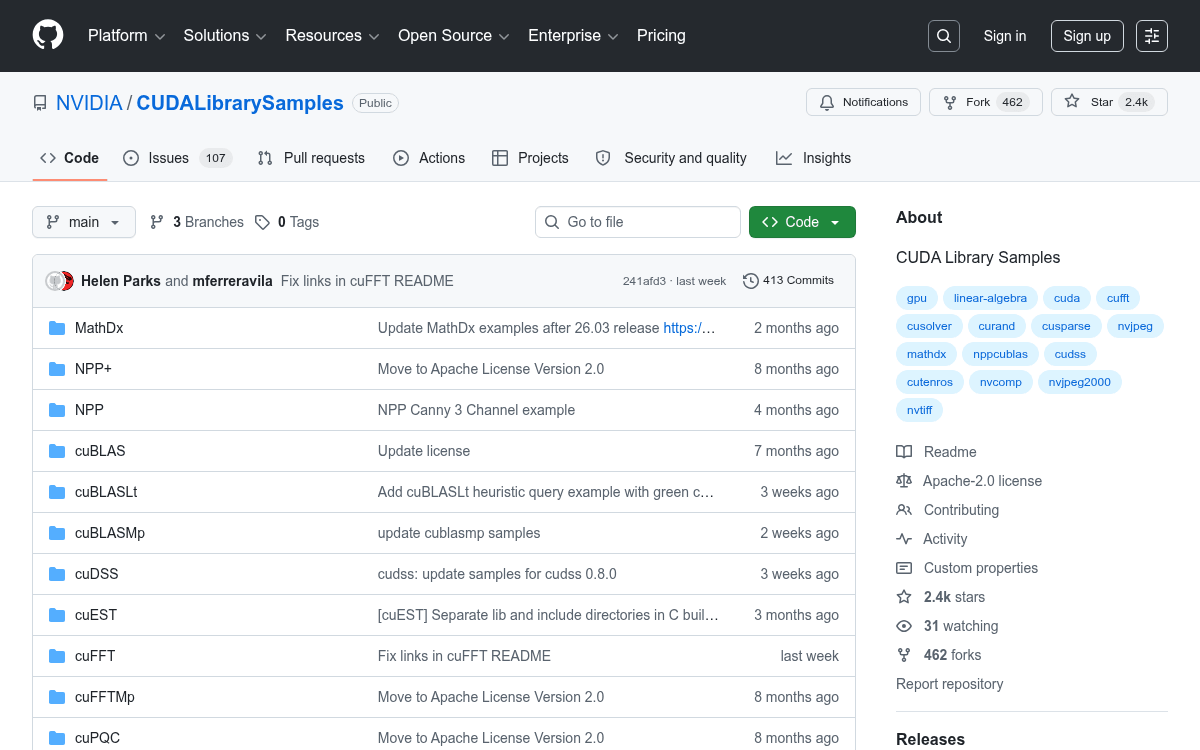
Takeaways
- Three new sample sets added to NVIDIA/CUDALibrarySamples: cuPQC, cuEST, and nvMatmulHeuristics.
- cuPQC accelerates NIST-standard post-quantum crypto (ML-KEM, ML-DSA) on GPU, with up to 500x speedup over CPU on H100.
- cuEST (beta) accelerates first-principles quantum chemistry, delivering up to 55x speedups; adopted by TSMC, Samsung, and Applied Materials.
- nvMatmulHeuristics provides analytic GEMM kernel selection without exhaustive benchmarking, supporting FP8 through FP64 and already integrated into CUTLASS 4.x.
- All samples are open source under Apache 2.0 and include build instructions and runnable examples.
- The libraries are available via the NVIDIA Developer portal; samples target data centers, ML compiler authors, and computational scientists.
NVIDIA's CUDALibrarySamples repository , the canonical place to find working code for every CUDA-X library , has been updated to include samples for three libraries that didn't have entries there before: cuPQC, cuEST, and nvMatmulHeuristics. For anyone trying to get started with these libraries, this is the most practical on-ramp available.
Three libraries, three very different problems
Each addition covers a distinct domain that has seen serious engineering investment from NVIDIA over the past year.
- cuPQC , post-quantum cryptography on the GPU
- cuEST , electronic structure calculations for quantum chemistry
- nvMatmulHeuristics , analytic kernel selection for matrix multiplications
The samples are open source under the Apache 2.0 license and are designed to be minimal, self-contained starting points rather than production-ready applications.
cuPQC: encrypting against tomorrow's quantum computers
Post-quantum cryptography (PQC) refers to cryptographic algorithms designed to resist attacks from quantum computers, which could break widely-used schemes like RSA. The threat is real even today because of "harvest now, decrypt later" attacks , adversaries hoard today's encrypted data with the aim of decrypting it using future quantum devices.
The cuPQC SDK contains two libraries: cuPQC and cuHash. cuPQC is designed to leverage the parallel processing power of NVIDIA GPUs to offer high-performance, batched, and secure implementations of post-quantum cryptographic algorithms. Specifically, it includes two of the NIST-standardized post-quantum cryptographic algorithms: ML-KEM and ML-DSA.
The SDK also includes cuPQC-Hash, covering SHA-2, SHA-3, SHAKE, and Poseidon2 hash functions with a Merkle Tree API. Both libraries are device-side extensions that integrate directly into your CUDA kernels. The performance case is strong: early benchmarks showed cuPQC accelerating Kyber , the algorithm that became ML-KEM , by up to 500x on an NVIDIA H100 compared with a CPU.