
NVIDIA's ProtoMotions 3 Trains Humanoid Robots on 142K Motions in 12 Hours
NVIDIA Labs releases ProtoMotions 3, an open framework that trains a humanoid policy on 40+ hours of motion in 12 hours and deploys zero-shot to real robots.
Takeaways
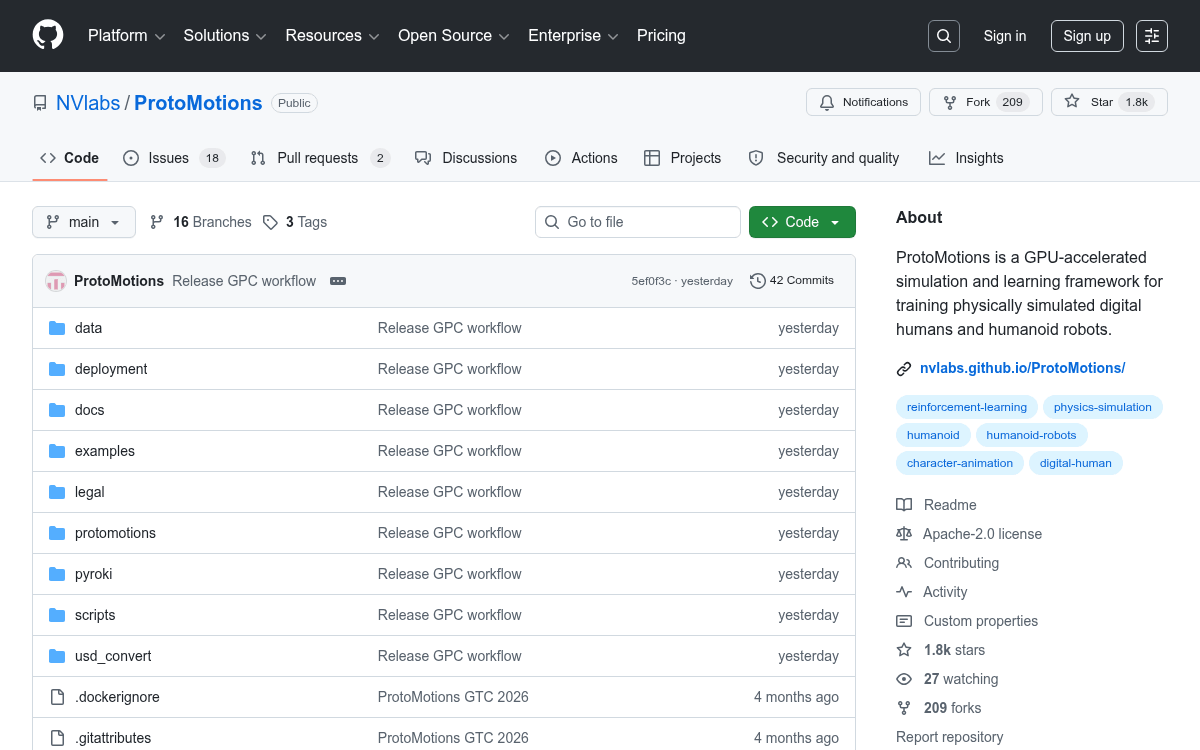
- NVIDIA Labs released ProtoMotions 3, an Apache 2.0 framework for humanoid simulation and control.
- Trains a character on 40+ hours of AMASS motion in 12 hours using 4 A100 GPUs.
- One command swaps between Newton, IsaacLab, IsaacGym, MuJoCo, and Genesis simulators.
- General Tracking Policy trained on 142K motions transfers zero-shot to a Unitree G1 robot.
- Single ONNX export bakes in observations, removing sim-to-real integration rewrites.
- Includes GPC/PEFT, MaskedMimic, AMP, ASE, PPO, and PyRoki retargeting out of the box.
NVIDIA Labs has pushed ProtoMotions 3, an open source stack that turns motion-capture datasets into physics-based control policies for both animated characters and real humanoid robots. The framework trains a fully physically simulated character to learn motion skills from the entire public AMASS human animation dataset, more than 40 hours of motion, within 12 hours on 4 A100s. The same trained policy can be exported to ONNX and dropped onto a Unitree G1 with no code rewrites.
The repo has crossed 2,301 stars and ships under Apache 2.0. It targets a messy intersection where character animation, reinforcement learning, and robotics have historically used incompatible tools, and it tries to make swapping any of those layers a one-flag change.
One codebase, five physics engines
The core design decision is a simulator abstraction that lets you flip backends from the command line. Users can test robot control policies on H1_2 or G1 in different physics engines with a single flag change from isaacgym to newton to mujoco, using only observations available on real hardware. Supported backends are:
- NVIDIA Newton 1.0.0, the new GPU physics engine
- IsaacLab 3.0 and IsaacGym Preview 4
- Genesis (GPU, community contributed)
- MuJoCo 3.0+ on CPU for sim-to-sim validation
That matters because sim-to-real gaps often hide inside a single simulator's quirks. Running the same policy across Newton, MuJoCo, and IsaacGym is a cheap sanity check before a robot eats its own feet.