
NVIDIA's Warp 1.14 Lets Developers Simulate Hundreds of Physics Worlds on One GPU
NVIDIA Warp 1.14.0 ships multi-environment FEM, CPU/GPU FFT fallbacks, pluggable logging, and a wave of autodiff fixes
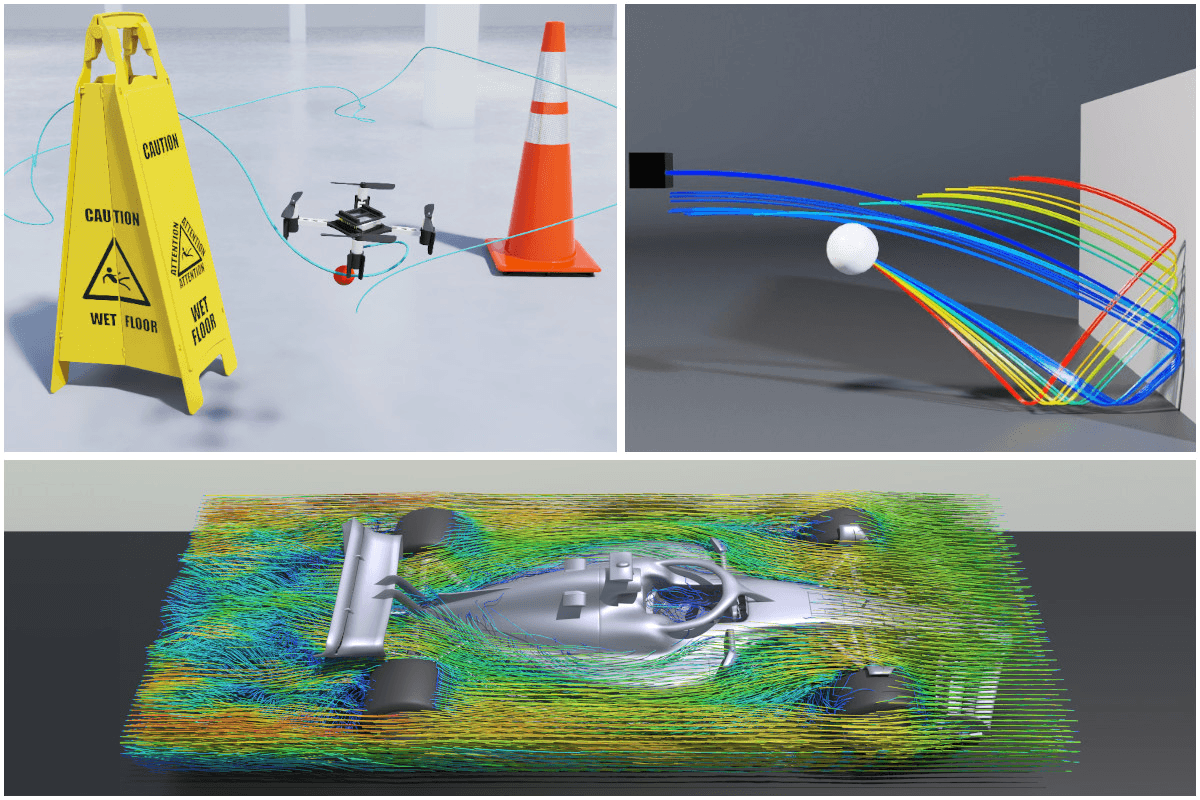
Takeaways
- Warp 1.14.0 is out on PyPI — NVIDIA's open-source Python-to-GPU simulation framework ships a significant update.
- Multi-environment FEM —
warp.femnow supports batched independent physics environments natively, key for RL training pipelines. - CPU/GPU FFT and Cholesky fallbacks — tile-based FFT and Cholesky solvers now work without libmathdx, enabling faster dev iteration.
- Reusable iterative solver state — CG, CR, BiCGSTAB, GMRES solvers gain a stateful API to avoid per-call allocation and enable CUDA subgraph use.
- Long-standing autodiff bugs fixed — in-place composite writes, NaN min/max semantics, curl noise gradients, and edge-edge stability all corrected.
- JAX experimental module deprecated —
warp.jax_experimentalAPIs promoted to top-levelwarpnamespace; removal scheduled for Warp 1.16.
NVIDIA Warp is an open-source Python framework that lets you write GPU-accelerated simulation code using plain Python functions, which it JIT-compiles into efficient CUDA or CPU kernels. Version 1.14.0 is now available on PyPI, and it is a meaty release: multi-environment support for the FEM toolkit, CPU-side FFT and Cholesky fallbacks, a new pluggable logging system, reusable iterative solver state, and a long list of autodiff correctness fixes that have been open issues for years.
Multi-environment FEM is the headliner
The biggest addition is multi-environment support in warp.fem. In simulation and robotics, you often want to run hundreds of independent physics environments in a single GPU batch , think reinforcement learning. Previously, doing this with Warp's finite element method (FEM) toolkit required manual workarounds. Now, Grid2D, Grid3D, Nanogrid, and AdaptiveNanogrid geometries all support environment-aware lookup, and PicQuadrature (a particle-in-cell quadrature scheme) gains per-environment particle indices. Unstructured FEM meshes get per-cell environment metadata and grouped BVH lookup. There is also a new multi-environment APIC fluid example to demonstrate the whole pipeline.
The release also extends APIC (Affine Particle-In-Cell) graph capture on CPU to replay backward (adjoint) kernel launches , including tile-using kernels and kernels with @wp.struct or wp.indexedarray arguments. One breaking change to be aware of: .wrp files saved by Warp 1.13 use the old serialization format and must be recaptured.
