
Sakana AI's ShinkaEvolve Beats AlphaEvolve Using 150 Samples Instead of Thousands
SakanaAI's open-source ShinkaEvolve uses LLM-guided evolution to discover state-of-the-art algorithms with orders of magnitude fewer evaluations than AlphaEvolve.
Takeaways
- What it is: ShinkaEvolve is an open-source (Apache 2.0) framework that uses LLMs as mutation operators in an evolutionary loop to automatically discover and improve algorithms.
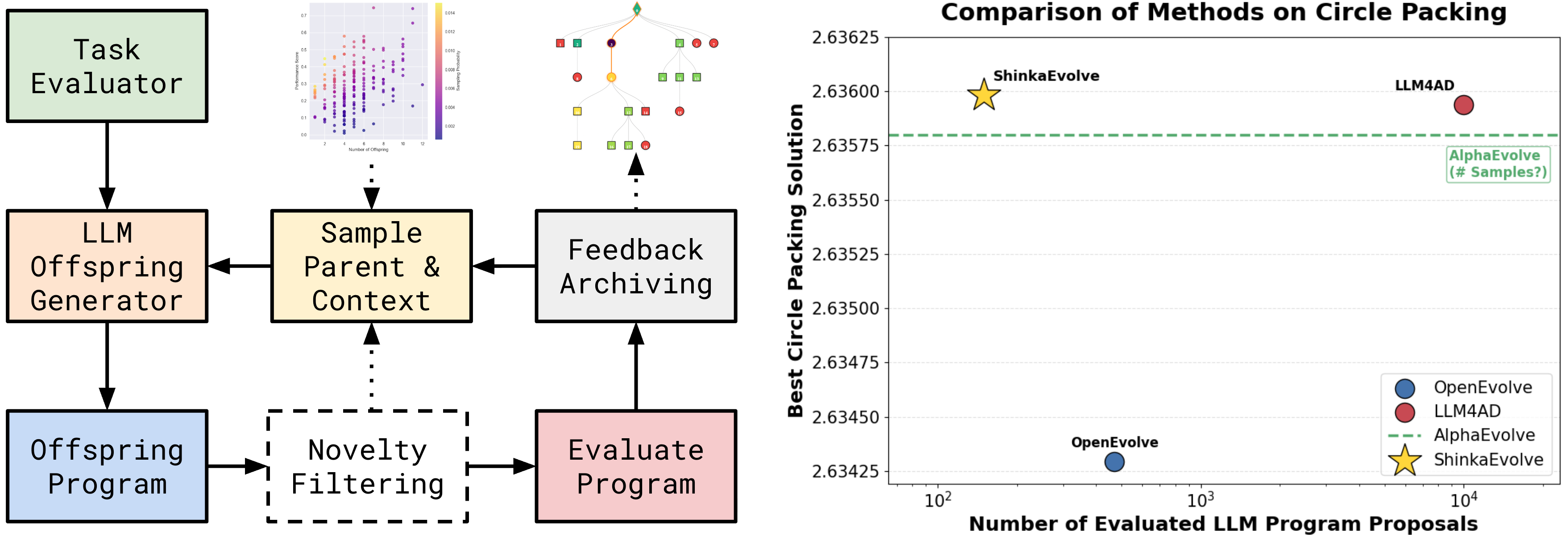
- Sample efficiency: Achieves state-of-the-art circle packing in 150 samples vs. thousands required by AlphaEvolve and FunSearch.
- Three core innovations: Adaptive parent sampling, novelty rejection-sampling to skip redundant mutations, and UCB1 bandit-based LLM ensemble selection.
- Proven across 4 domains: Circle packing, AIME math reasoning, competitive programming (ICFP 2025 winner), and MoE load balancing loss design.
- Easy to use: Install via
pip install shinka-evolve; just provide anevaluate.pyscorer and aninitial.pystarting solution. - ICLR 2026 paper: Accepted and published at ICLR 2026; latest update adds support for Headless CLI models like GPT-5.5 and Claude via subscription.
ShinkaEvolve is an open-source framework from Sakana AI that uses large language models as mutation operators inside an evolutionary loop to automatically discover and improve algorithms. It was accepted at ICLR 2026, and the team has been actively shipping updates ever since. The core pitch is simple but striking: do what AlphaEvolve does, but use orders of magnitude fewer LLM calls to get there.
The Sample Efficiency Problem Nobody Was Talking About
The field of LLM-driven scientific discovery has seen significant progress, but has yet to overcome a critical limitation: sample inefficiency, requiring thousands of samples to identify effective solutions. Systems like AlphaEvolve and FunSearch are powerful, but they are essentially expensive brute-force searches. Where FunSearch and AlphaEvolve rely on large evaluation budgets enabled by proprietary compute infrastructure, ShinkaEvolve is designed for researchers with limited budgets.
The headline result makes the point concretely: when applied to the canonical circle-packing optimization task, ShinkaEvolve discovers a new state-of-the-art circle packing solution using only 150 samples, orders of magnitude fewer than prior frameworks. That is not a minor speedup. It is the difference between a weekend experiment and a months-long compute bill.
Three Innovations That Actually Move the Needle
ShinkaEvolve takes a concrete step towards addressing this critical limitation by introducing three key innovations: a parent sampling technique balancing exploration and exploitation, code novelty rejection-sampling for efficient search space exploration, and a bandit-based LLM ensemble selection strategy. Here is what each of these actually does:
- Adaptive parent sampling: Instead of randomly picking which previous program to mutate next, the system uses a weighted selection strategy that balances exploiting the best known solutions against exploring new directions. Think of it as a smarter version of tournament selection.