| Hey, | Welcome to AlphaSignal – the most read newsletter by AI developers.
We bring you the top 1% of news, papers, models, and repos, all summarized to keep you updated on the latest in AI. |
|
|
|
IN TODAY'S SIGNAL
| Read time: 5 min 32 sec | 🎖️ Top News
⚡️ Trending Signals
💻 Top Lectures
🧠 Deep Dive
|
|
|
|
If you're enjoying AlphaSignal please forward this email to a colleague.
It helps us keep this content free. |
|
|
|
TOP NEWS
| Research Agent | Google presents AI co-scientist, a multi-agent system, which generates and refines hypotheses in days
| ⇧ 13,583 Likes |
| What's New |
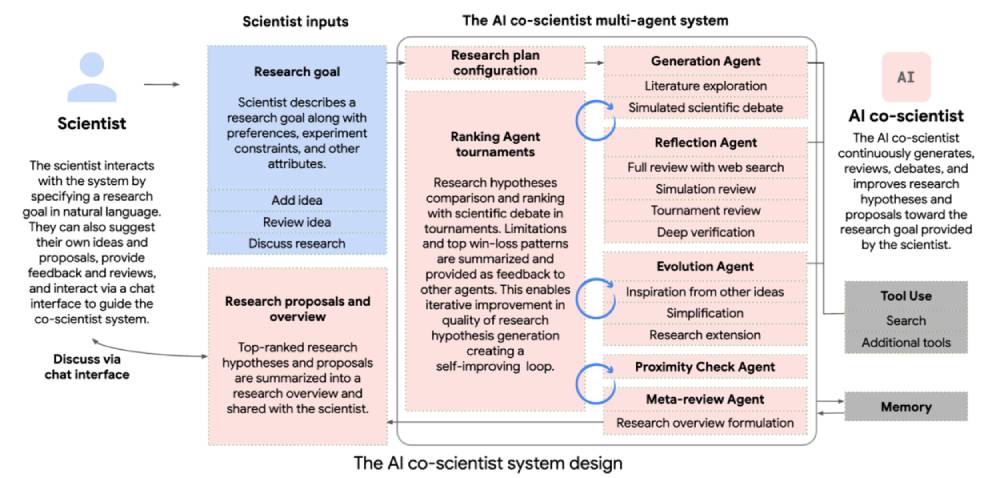
Google launches AI co-scientist, a multi-agent system built on Gemini 2.0 to generate and refine scientific hypotheses. You can use it to automate hypothesis generation, evaluation, and refinement.
The system mimics the scientific method, applying structured reasoning across multiple domains. It processes large amounts of scientific literature, integrates insights from different fields, and produces novel, testable research directions.
Key Highlights
Goal
The system mimics the scientific method, applying structured reasoning across multiple domains. It processes large amounts of scientific literature, integrates insights from different fields, and produces novel, testable research directions. It aims to improve hypothesis generation efficiency, allowing scientists to focus on experimental validation.
Multi-Agent Architecture
AI co-scientist operates with a Supervisor agent that assigns tasks to six specialized agents: - Generation: Creates initial hypotheses.
- Reflection: Evaluates and refines generated hypotheses.
- Ranking: Prioritizes hypotheses based on quality and novelty.
- Evolution: Iteratively improves selected hypotheses.
- Proximity: Ensures hypotheses remain grounded in relevant research.
- Meta-review: Conducts a final assessment before output.
Performance Benchmarks
Google evaluates AI co-scientist on GPQA diamond questions and real-world research tasks, measuring accuracy, reasoning quality, and hypothesis refinement. - Elo auto-evaluation: Higher Elo ratings correlate with a higher probability of correct answers. AI co-scientist achieves a consistent increase in accuracy as Elo ratings improve.
- Expert evaluation: In 15 open research tasks, AI co-scientist outperforms state-of-the-art reasoning models.
- Test-time compute scaling: Performance improves with more computation, refining hypotheses iteratively.
Experimental Validations
The AI co-scientist is tested in real-world research, generating hypotheses that are experimentally validated: - Drug repurposing for AML: It predicts three novel drug candidates, which are confirmed through laboratory tests to inhibit tumor viability at clinically relevant concentrations.
- Liver fibrosis research: It identifies epigenetic targets with anti-fibrotic activity, which are validated in human hepatic organoids.
- Antimicrobial resistance studies: It independently rediscovers a bacterial gene transfer mechanism, aligning with unpublished findings from researchers.
Availability and Access
Google offers AI co-scientist to research organizations through a Trusted Tester Program. You can interact with the system by providing research goals and refining hypotheses based on generated outputs. |
|
| Learn more
|
|
|
|
TRENDING SIGNALS
| AI Model |
|
⇧ 49,594 Likes | |
Reasoning Model |
|
⇧ 8,385 Likes | |
Quantum Computing |
|
⇧ 1,57,586 Likes | |
Coding Assistant |
|
⇧ 1,486 Likes | |
AI Optimization |
|
⇧ 3,057 Likes | | |
|
|
|
|
TOP LECTURES
| App Development |
| ⇧ 3,138 Likes |
Learn how to build an app using OpenAI o1 Pro with a structured six-prompt workflow. This lecture covers generating repositories, planning, and coding with AI-driven prompts. You'll set up essential tools like GitHub, Supabase, Clerk, Stripe, and OpenAI, and walk through the workflow, including prompts for request, spec, planner, and codegen. Part 1 covers the basics; Part 2 dives into advanced project building. Automate code generation in multiple steps. |
| AI Scaling Techniques |
| ⇧ 3,193 Likes |
This book from Hugging Face explains 5D parallelism, ZeRO, CUDA kernel optimizations, and compute-communication overlap in large-scale AI training. It breaks down scaling bottlenecks, PyTorch internals, and parallelism techniques like ZeRO-3, pipeline, sequence, and context parallelism. Learn how DeepSeek trained for $5M, why Mistral used MoE, and how FP8 compares to BF16. |
| Agents |
| ⇧ 2,395 Likes |
Learn AI agent fundamentals, agentic frameworks, and design patterns like tool use, planning, and metacognition. The course covers agentic RAG, multi-agent systems, and deploying AI agents in production, offering practical knowledge for developers and engineers. Explore trustworthy AI and production deployment. |
| |
| |
|
|
DEEP DIVE
| AI Industry |
Satya Nadella Discusses AI, AGI, and Microsoft’s Quantum Leap
| ⇧ 13,573 Likes |
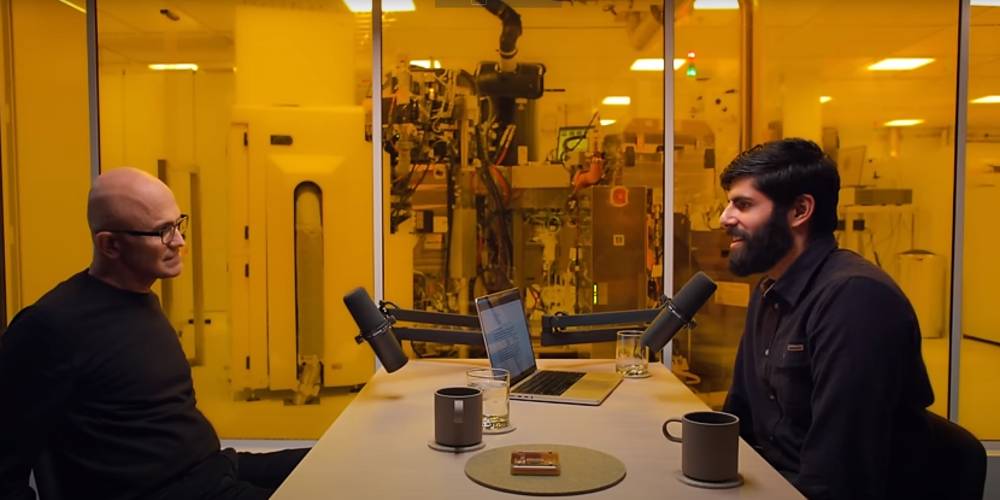
| The podcast features Satya Nadella discussing AI, quantum computing, and economic growth. He explains why he doubts AGI but expects AI to drive 10% economic growth. He details Microsoft’s topological qubit breakthrough and its implications for quantum computing. He explores the impact of AI on software pricing, including whether Office commoditizes LLMs or the reverse.
You will learn Satya Nadella's thought on: - Why AI won’t be winner-take-all
- How AI could drive 10% economic growth
- The decreasing price of intelligence and its economic effects
- Microsoft’s quantum computing advancements
- How Microsoft models gaming worlds using AI
- Legal challenges in AI adoption
- AGI safety considerations
- His perspective on AGI after 34 years at Microsoft
|
| Watch now
|
|
|
|
At Alpha Signal, our mission is to build a sharp, engaged community focused on AI, machine learning, and cutting-edge language models, helping over 200,000 developers stay informed and ahead. We’re passionate about curating the best in AI, from top research and trending technical blogs to expert insights and tailored job opportunities. We keep you connected to the breakthroughs and discussions that matter, so you can stay in the loop without endless searching. We also work closely with partners who value the future of AI, including employers and advertisers who want to reach an audience as passionate about AI as we are.
Our partnerships are based on shared values of ethics, responsibility, and a commitment to building a better world through technology.Privacy is a priority at Alpha Signal. Our Privacy Policy clearly explains how we collect, store, and use your personal and non-personal information. By using our website, you accept these terms, which you can review on our website. This policy applies across all Alpha Signal pages, outlining your rights and how to contact us if you want to adjust the use of your information. We’re based in the United States. By using our site, you agree to be governed by U.S. laws. |
|
|
|
Looking to promote your company, product, service, or event to 200,000+ AI developers? Let's work together.
|
| Work with us
|
|
|
|
|
