|
Hey,
Your daily briefing is ready. You can finally take a break from the AI firehose.
Our algos spent the night splitting signal from noise and pulled the top news, models, papers, and repos.
Here’s the must-read:
|

|
Today's Author
Lior Alexander. Founder of AlphaSignal and former ML Engineer.
Previously built ML systems at Iguazio, Guesty, Enphase, Mila.
|
|
Top Paper
|
|
|
|
Meta introduces Self-play SWE-RL, where one model improves coding by generating and fixing its own bugs
|
|
1,648 Likes
|
|
Self-play SWE-RL starts from a simple observation: today’s software agents learn almost everything from humans.
They train on GitHub issues, pull requests, and curated tests, which caps how far they can go. The paper asks a harder question: can an agent learn software engineering by teaching itself?
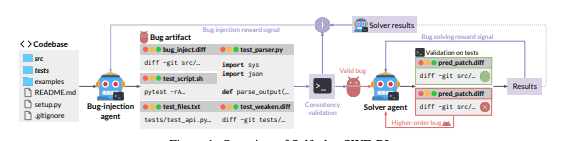
The core idea is to turn software development into a self-play game. One LLM plays both sides. First, it breaks real code by injecting bugs. Then, it switches roles and fixes those bugs using tests as the only source of truth.
No natural language issues, no human-written labels, just code, dependencies, and execution.
This setup matters because tests give unambiguous feedback. A test either passes or fails. That makes reinforcement learning stable and scalable in real repositories.
Key features
-
Trains on real-world codebases with installed dependencies and executable tests
-
Alternates between bug injection and bug repair inside one agent
-
Defines bugs through test patches instead of natural language descriptions
-
Uses git resets and sandboxing to avoid information leakage
Results
-
Improves SWE-Bench Verified by +10.4 points
-
Improves SWE-Bench Pro by +7.8 points
-
Beats an RL baseline trained on human issue data throughout training
|
|
|
|
Presented by Sonar Source
|
|
Get more ROI out of AI coding tools
|

|
AI coding assistants can speed up development but they also introduce new risks. Without proper verification, you end up trading speed for hidden defects and security issues.
SonarQube acts as the verification layer for AI-generated code. It helps you move fast while maintaining quality, security, and maintainability across the codebase.
Teams using SonarQube report:
-
20% higher likelihood of improved defect rates
-
24% lower vulnerability exposure
-
18% reduction in rework and patch costs
-
19% higher effectiveness when using AI-assisted coding
Build faster without compromising quality.
|
|
|
|
partner with us
|
|
Top Paper
|
|
|
|
Stanford-Harvard researchers explain agentic AI fails without real-time adaptation during tasks
|
|
3,379 Likes
|
|
A new Stanford-Harvard paper explains a pattern you have likely seen: agentic AI systems look strong in demos and then break in real use.
The paper, Adaptation of Agentic AI, studies why this happens across modern agent designs. The most striking insight is simple: agents fail not because they reason poorly, but because they do not adapt once execution starts.
The problem starts with how most agents work today. You give an agent a goal, it forms a plan, and it executes step by step.
This works only if the world behaves exactly as expected. When tools fail, outputs degrade, or assumptions break, most agents continue anyway.
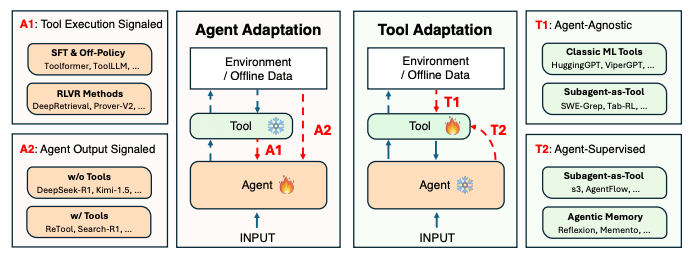
The paper reframes the solution around adaptation, which means changing behavior during a task based on feedback, not retraining or prompt edits.
Feedback comes from tool results or output evaluations, such as correctness checks.
Key ideas
-
Distinguishes execution from adaptation as separate system capabilities
-
Introduces a 2×2 framework covering agent and tool adaptation paths
-
Shows adaptive agents handle long-horizon and partial-information tasks better
-
Finds external memory outperforms long internal reasoning chains
-
Identifies rigid tool selection as a major failure source
|
|
|
|
Top News
|
|
|
|
Alibaba's Qwen unveils two Flash TTS models focused on voice design and fast multilingual cloning
|
|
1,387 Likes
|
|
Qwen expands its text-to-speech stack with Qwen3-TTS-VD-Flash and Qwen3-TTS-VC-Flash, two API models aimed at controllable voice generation.
TTS systems usually force you to pick preset voices or clone existing ones with long recordings. Qwen targets that gap by combining instruction following with short-sample cloning.
The key idea is simple: treat voice as a programmable object.
VD-Flash turns natural-language descriptions into acoustic controls. VC-Flash extracts a voice from seconds of audio and reproduces it across languages.
You describe what the voice is or what it should sound like, then supply text.
Key features
-
Natural-language control over timbre, prosody, emotion, persona, and speaking style
-
Persistent voice IDs for consistent multi-turn and multi-role dialogue
-
3-second voice cloning with multilingual speech generation
-
Robust parsing of complex and non-standard text inputs
Performance results
-
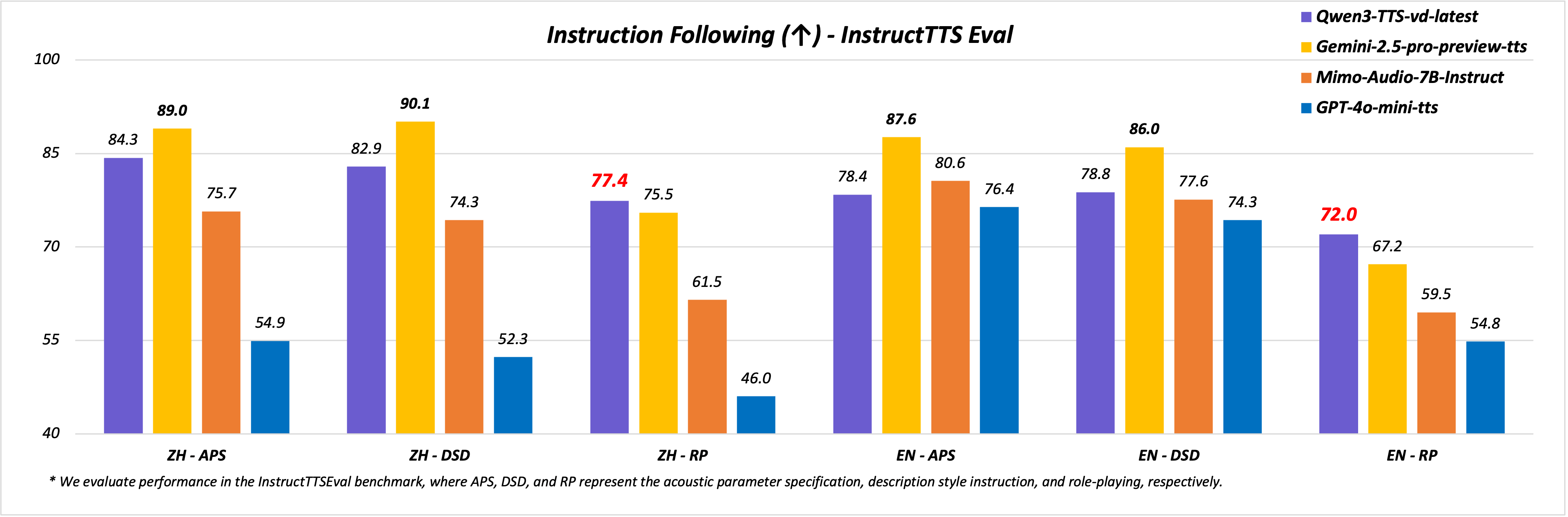
90.1 overall score on InstructTTS-Eval
-
Higher APS and DSD scores than GPT-4o-mini-tts and Mimo-Audio-7B-Instruct
-
Higher role-play scores than Gemini-2.5-pro-preview-tts
-
Best average WER on the MiniMax TTS Multilingual Test Set
|
|
|
At Alpha Signal, our mission is to build a sharp, engaged community focused on AI, machine learning, and cutting-edge language models, helping over 200,000 developers stay informed and ahead. We’re passionate about curating the best in AI, from top research and trending technical blogs to expert insights and tailored job opportunities. We keep you connected to the breakthroughs and discussions that matter, so you can stay in the loop without endless searching. We also work closely with partners who value the future of AI, including employers and advertisers who want to reach an audience as passionate about AI as we are.
Our partnerships are based on shared values of ethics, responsibility, and a commitment to building a better world through technology.Privacy is a priority at Alpha Signal. Our Privacy Policy clearly explains how we collect, store, and use your personal and non-personal information. By using our website, you accept these terms, which you can review on our website. This policy applies across all Alpha Signal pages, outlining your rights and how to contact us if you want to adjust the use of your information. We’re based in the United States. By using our site, you agree to be governed by U.S. laws.
|
|
|
Looking to promote your company, product, service, or event to 250,000+ AI developers?
|
|
|
|
|
