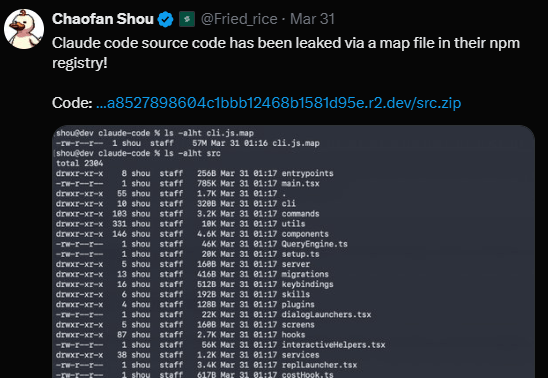
On March 30, 2026, an npm packaging error leaked roughly 512,000 lines of TypeScript from Anthropic's flagship Claude Code CLI tool. The leak occurred when version 2.1.88 shipped with a 59.8 MB JavaScript source map file that pointed to the unobfuscated original code.
Within hours, researchers mirrored the code to GitHub. Anthropic confirmed the incident was a human error in release packaging, not a security breach, and began issuing takedowns.
But what the leak really did was challenge one of the popular beliefs in the field.
The industry has largely treated tools like Claude Code as simple interfaces that route commands to a very powerful model. But the leaked codebase revealed a complex harness filled with memory systems, feature flags, and multi-agent coordination logic.
This exposure arrives at a critical moment. Large language models (LLMs) are commoditizing, and the capability gap between frontier models is rapidly diminishing. For most common applications, the difference between frontier models is diminishing.
A popular narrative claims that advances in LLMs will soon obviate the need for software engineering skills, since the model will be able to handle everything. The Claude Code leak proves the exact opposite.
The technical and economic moat in AI is shifting to "harness engineering." AI will not replace software engineers. It will provide them with opportunities to create incredibly powerful software, provided they build the right scaffolding and orchestration layer on top of the models.
Inside the harness: The architecture of agency
Raw LLMs have serious limitations, ranging from context degradation to unpredictable tool execution and vulnerabilities to prompt injection attacks and jailbreaks.
The leaked code provides a blueprint for how to overcome these flaws through strict software engineering patterns.
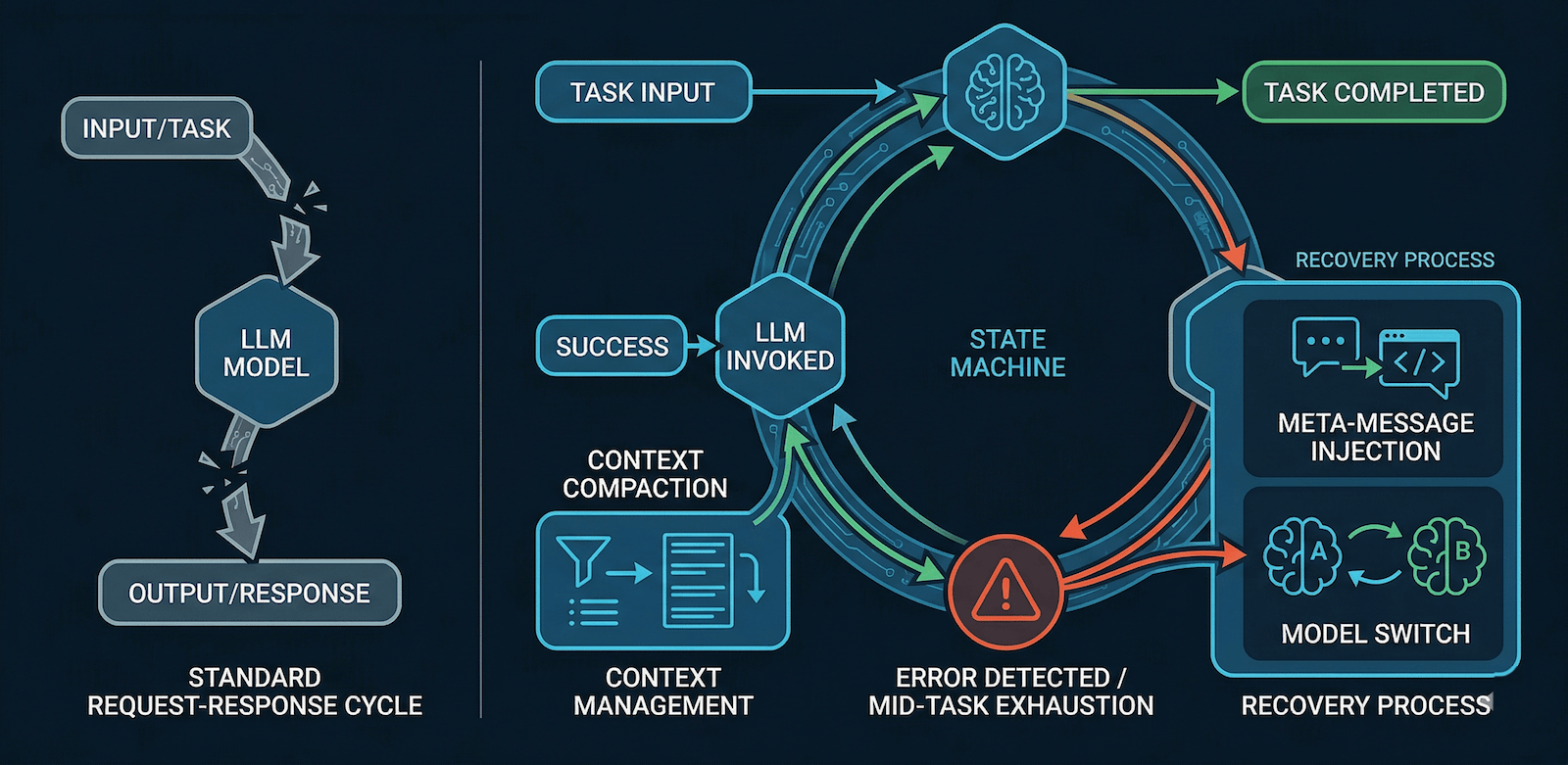
The self-healing query loop: Claude Code abandons the standard request-response cycle. It relies on a continuous state machine designed to absorb errors silently.
If a model exhausts its output budget mid-task, the loop does not crash. It executes automated recovery strategies, such as injecting an invisible meta-message to resume generation or switching models.
The loop also uses compaction techniques to trim low-value messages from the context window. This is necessary because of the attention mechanism, the mathematical process models use to weigh the relevance of every past word.
Attention computation scales quadratically, making large contexts both slow and expensive. Compacting the history prevents the model from collapsing under its own weight.
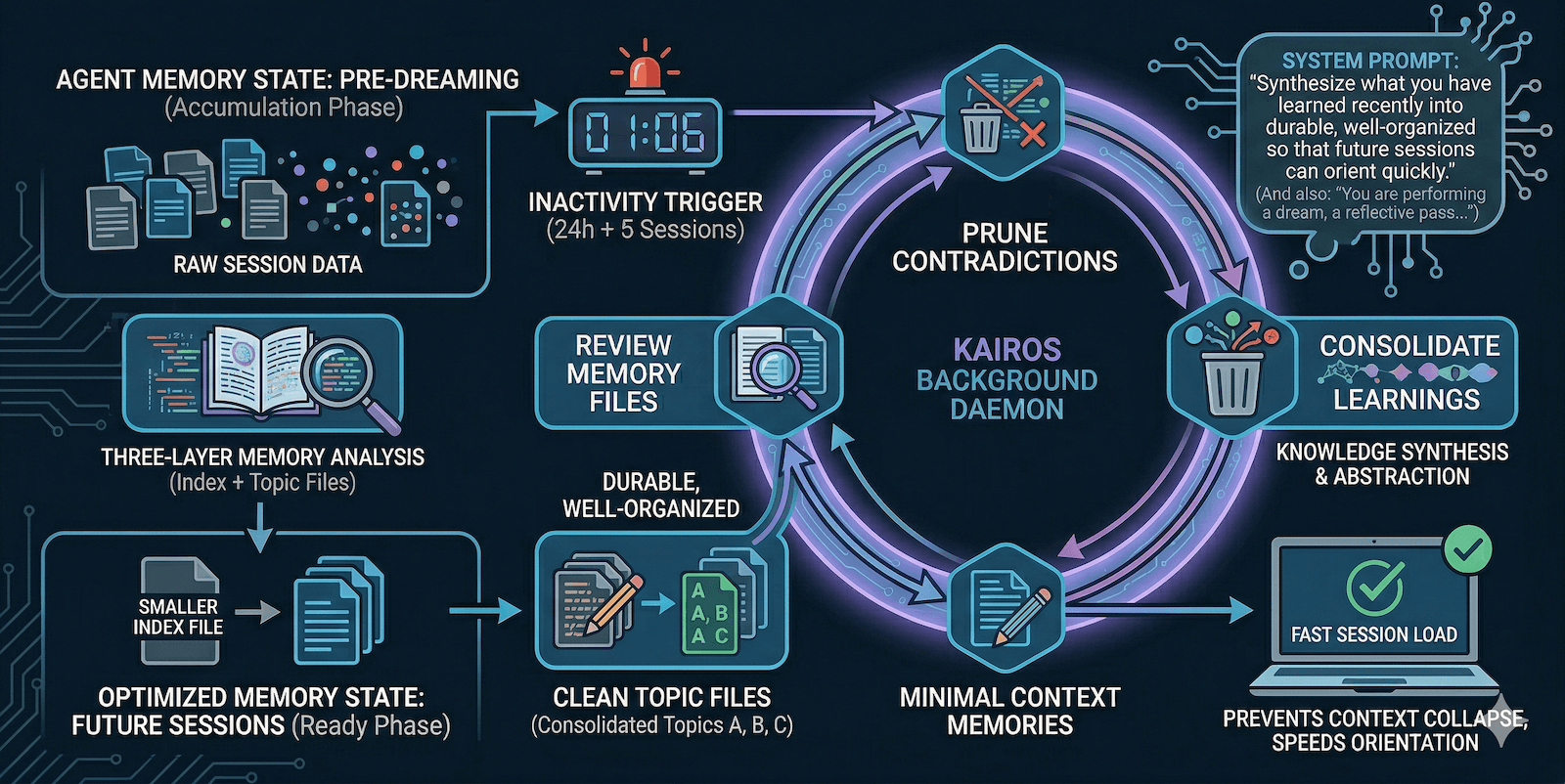
Sleep-time compute and memory consolidation: To manage long-term state, the harness uses a background daemon called KAIROS, or Dream Mode. After 24 hours of inactivity and a minimum of five sessions, this daemon wakes up to review the agent's memory files.
The system uses a three-layer memory design. It maintains a lightweight index file and separates actual data into distinct topic files.
The daemon acts as a garbage collector. It prunes contradictions, consolidates learnings, and rewrites the files. It keeps the index small enough to load into future sessions without bloating the active context window.
This "dreaming" mechanism is inspired by our knowledge of how sleep organizes memories in the human brain. The system prompt for the subagent is: "You are performing a dream, a reflective pass over your memory files. Synthesize what you have learned recently into durable, well-organized memories so that future sessions can orient quickly."
Opinionated and concurrent tooling: The codebase avoids generic shell access. Giving an AI raw terminal commands is dangerous and prone to hallucinations or prompt injection attacks.
Instead, Anthropic built specialized, structured tools like dedicated grep and glob functions. The harness also implements strict write discipline, ensuring index updates only happen after successful file writes.
The orchestration layer batches these tools based on concurrency safety. Read tools run in parallel, while write tools execute serially.
To further optimize latency, the harness sorts tool lists alphabetically before sending them to the API. This stabilizes the KV cache, the memory store that saves the key and value vectors of previously processed tokens.
When the tool list stays identical, the model hits the KV cache. This allows it to skip the compute-heavy "prefill" phase, where it reads the prompt, and jump straight to the "decode" phase to generate tokens sequentially.
The Poetiq proof and the paradigm shift
The necessity of harness engineering extends beyond Anthropic's Claude Code. It is rapidly becoming the industry standard for pushing AI systems past their raw limitations.
Poetiq, a startup founded by former DeepMind researchers, recently proved this by achieving state-of-the-art results on the ARC-AGI-2 benchmark. They reached 54% accuracy at a cost of $30.57 per problem.
The previous record holder was Gemini 3 Deep Think, which scored 45% at $77.16 per problem. Poetiq delivered a higher score at less than half the cost.
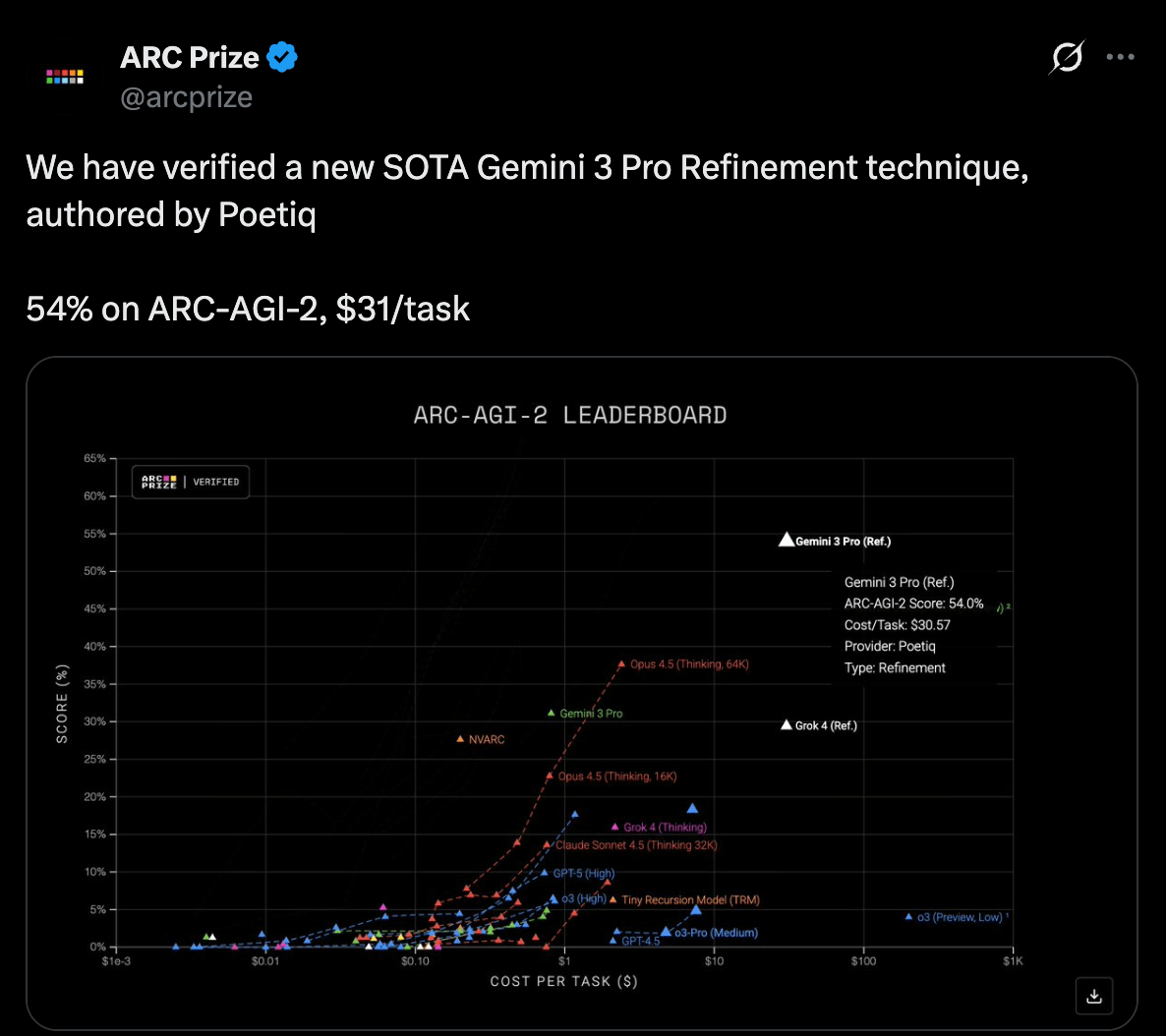
Importantly, Poetiq did not train a new model. They built a recursive, self-improving meta-system on top of existing frontier models like Gemini 3 Pro.
On its own, the Gemini 3 Pro baseline scored only 31% at $0.81 per task. Poetiq wrapped the model in an orchestration layer that decomposes puzzles, generates Python programs, executes them, and analyzes failures autonomously.
The system includes self-auditing to decide when it has enough information to terminate, preventing wasteful compute. This proves that the orchestration layer (or the harness) is what unlocks peak performance. You can swap the underlying model, but the verification and cost-control systems solve the actual problem.
The best time to be a software engineer?
The limitations of raw LLMs can only be solved by robust systems engineering. Because of this, there has never been a better time to be a software engineer.
Professionals who can build strong harnesses around AI will thrive. Those who rely solely on prompt engineering or one-shot vibe coding will find their skill sets commoditized alongside the base models.
One area that is worth watching is how these orchestration layers evolve into systems that solve the challenges of A2A (Agent to Agent) ecosystems.
Developers should put their skills to use by studying model strengths and limitations and designing architectures to overcome them.
This means focusing on persistent memory indexing, self-auditing verification loops, and cost-aware tool orchestration. The Claude Code leak showed us that the LLM is just the processor. The software engineers must still build the operating system.