Building a basic voice interface around a large language model is remarkably easy in a local development environment. However, developers quickly find that perfectly tuned prototypes frequently fall apart when exposed to the chaotic reality of real-life applications, especially as users are increasingly expecting voice agents to provide them with a fluid, human-like experience.
The industry has largely solved conversational logic, making agents sound smart and coherent in text. Yet, raw audio processing remains a critical bottleneck, especially for real-time voice deployments.
Consider a customer service voice assistant built to register IT support tickets. A user calls from a noisy room and speaks with a heavy accent, attempting to dictate a complex alphanumeric string like a router MAC address.
A standard streaming speech-to-text model will often misinterpret these obscure characters, registering wrong information in the ticket. A larger, asynchronous model might get the details right, but it is slow and the resulting processing lag creates an awkward pause on the line. The user assumes the bot failed to hear them and repeats the address exactly as the agent starts speaking.
This simple misunderstanding causes the entire interaction to collapse into a frustrating loop. The conversational illusion shatters, forcing the user to hang up or demand a human representative.
The last-mile challenges of voice deployment
The example you just read is representative of the last-mile challenge in the voice AI industry.
Voice AI agents share a fundamental engineering hurdle with self-driving cars. Reaching 95% accuracy in a controlled vacuum is a straightforward milestone, but handling the final 5% of unpredictable edge cases dictates whether the system succeeds or fails.
When pushing voice applications to production, engineering teams typically run into two distinct challenges that degrade the overall user experience:
- Latency constraints: Standard asynchronous speech-to-text models process audio well, and can handle nuances such as accent, background noise, etc. But they introduce severe network latency. In agentic applications, response times need to mirror natural human conversation. If an agent takes too long to respond, users become confused about turn-taking and the conversational flow breaks down.
- Linguistic messiness: Capturing domain-specific entities, such as specialized product names or proprietary industry jargon, causes standard models to fail at a disproportionately high rate. The models must also track rapid speaker changes and ignore non-speech audio like coughs or background static without breaking the active transcription sequence.
When an agent fails to capture these details accurately, the consequences cascade through the application. For example, mistranscribing a proper noun or an email address creates downstream database errors, breaks the operational pipeline, and generates extra manual work to resolve the bad data.
Bridging the gap with AssemblyAI's Universal-3 Pro
AssemblyAI designed its Universal-3 Pro Streaming model specifically to eliminate these operational friction points for developers. Universal-3 Pro Streaming is a Speech Language Model with state-of-the-art accuracy and latency.
Historically, engineering a streaming architecture forced developers to accept a harsh tradeoff between low latency and high accuracy. Universal-3 Pro Streaming breaks that compromise by addressing the most difficult last-mile problems in three ways.
- Real-time context: The model processes complex audio with a P50 latency under 300 milliseconds. This near-instantaneous speed eliminates the asynchronous delay problem, improving voice agent conversion rates by keeping users engaged in a fluid conversation.
- Advanced promptability: Developers can feed the model domain-specific key terms before a session begins or during your conversation. This proactive guidance ensures the agent captures tricky data elements (e.g., rare credit card formats, company and product names, alternative name spellings) perfectly as the audio arrives.
- Global scale: The model addresses the reality of global deployments natively, supporting English, Spanish, French, German, Italian, and Portuguese out of the box. Bilingual callers can switch languages mid-sentence without crashing the transcription pipeline.
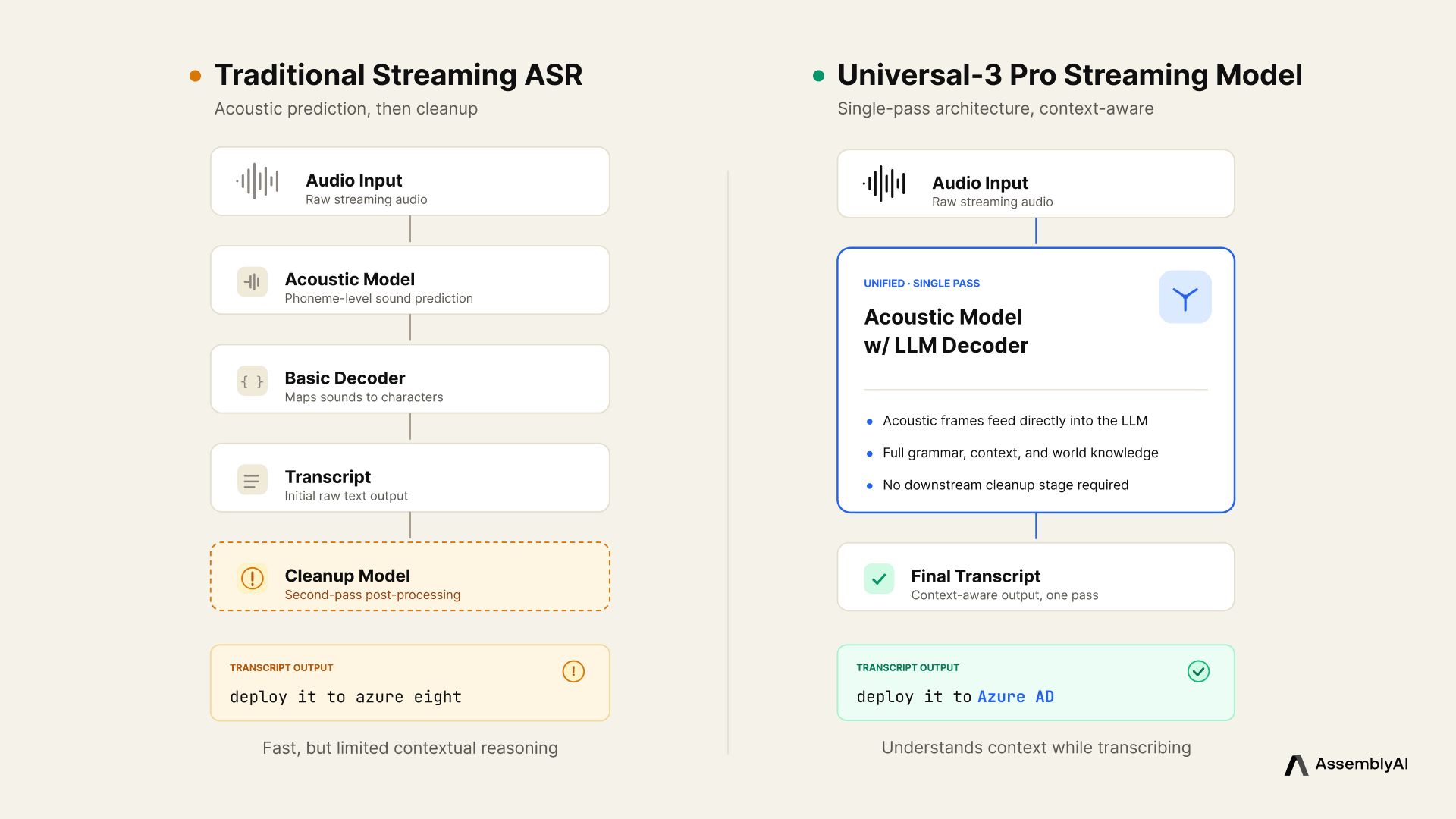
But how does Universal-3 Pro achieve this? Most streaming transcription systems are optimized for one thing: turning speech into text as quickly as possible. They're excellent at capturing what was said at the acoustic level, but they have limited capacity to reason about what the speaker meant. Subtle cues, proper nouns, homophones, domain-specific terminology, the flow of a real conversation, typically, require a separate post-processing pass to get right, or are handled by a small language model component bolted onto the end of the transcription pipeline.
Universal-3 Pro takes a different approach: it uses a large language model as the decoder itself. The acoustic side of the model still does what acoustic models do well, listening frame-by-frame and tracking the fine-grained sounds of speech as they unfold. But instead of handing those predictions off to a narrow, ASR-specific output head, Universal-3 Pro feeds them directly into an LLM that generates the transcript the same way it would generate any other text, with a full grasp of grammar, context, and real-world knowledge shaping every word it emits.
The result is transcripts that reflect not just what the audio sounded like, but what a fluent reader would expect the speaker to have meant, produced in a single pass, without a downstream cleanup stage.
 Unlocking high-stakes applications
Solving these real-time friction points goes far beyond repairing broken customer service interactions. Reliable, low-latency audio processing unlocks the potential for voice AI in zero-tolerance environments where mistakes carry severe consequences.
For example, in the healthcare sector, precision regarding specialized terminology is an absolute requirement. A system cannot mistake a critical medication dosage or a complex procedure name, as patient safety depends on exact documentation.
The added accuracy of models such as Universal-3 Pro Streaming allows health systems to deploy ambient clinical documentation agents that passively listen and structure medical notes, freeing doctors to focus entirely on their patients instead of verifying transcripts on a screen.
The same benefits can extend into heavy industrial settings. In manufacturing floors or noisy dispatch centers, distinguishing a short, vital command over loud acoustic background interference is critical for operational safety and efficiency.
The infrastructure layer for voice AI has finally caught up to the ambition of the development community. The core engineering bottleneck has decisively shifted away from the limitations of acoustic models and back to the imagination of the developers building the next generation of applications.
The only question left is what you'll build with it. Get a free API key and stream your first transcript with Universal-3 Pro Streaming in minutes. AssemblyAI offers $50 in credits to start, no credit card required.